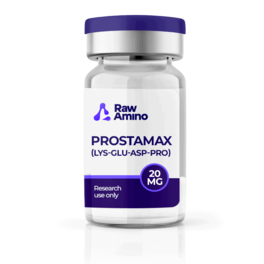
What Is Prostamax?
Prostamax peptide is one of the more specialized compounds currently being explored across prostate peptide research, cellular aging, and immune cell biology circles within the Khavinson bioregulator family. It is a synthetic tetrapeptide with the amino acid sequence Lys-Glu-Asp-Pro, and has been proposed as a potential facilitator of reparative mechanisms across diverse tissues, particularly in prostate cell cultures in laboratory settings.
Researchers have proposed that Prostamax may influence chromatin structural dynamics in laboratory models, with a potential to activate genes previously in a repressed state and induce alterations in chromosomal dynamics. Observable interactions noted by researchers in laboratory settings include an elevated frequency of sister chromatid exchanges and heightened nucleolus organizer region activity, indicative of intensified chromosomal exchange activities and modifications in ribosomal RNA gene function. This combination of proposed tissue-specific and broader epigenetic interactions has made Prostamax peptide a subject of growing interest across multiple laboratory research disciplines.
Prostamax Peptide and Prostate Gland Research
At the core of Prostamax prostate peptide research is its proposed potential to moderate inflammatory processes in prostate tissue in laboratory models. Research by Zakutskiy et al. in rat models suggested that Prostamax peptide may potentially act as a moderator of prostatitis-related changes in laboratory settings. Rats subjected to a 15-day Prostamax peptide regimen appeared to exhibit reduced swelling of the prostate gland, diminished vascular congestion, and decreased immune cell infiltration in these laboratory models. A reported decrease in scarring within the prostate tissue further suggested a possible deceleration of pathological remodeling associated with inflammation in these experimental settings. Researchers proposed that peptides such as Prostamax may have potential for the stimulation of reparative processes in appropriate tissues during aging, based on these laboratory observations.
A further investigation by Borovskaya et al. examined Prostamax peptide within animal models of chronic aseptic prostatitis in laboratory settings. Experimental studies indicated a possible capacity to moderate the severity of chronic inflammation in murine models, encompassing aspects including swelling, vessel hyperemia, and lymphoid infiltration. Researchers noted that Prostamax peptide exposure appeared to have led to the alleviation of inflammation-related observations in these laboratory models, with a particularly notable potential in moderating the development of sclerotic and atrophic processes in the prostate gland models studied. Its proposed interactions in moderating these complications appeared more pronounced when compared to comparator agents in laboratory settings, making this an active area of Prostamax prostate peptide research.
Prostamax Peptide and Cellular Aging Research
One of the more mechanistically detailed areas of Prostamax peptide research involves its proposed interactions with chromatin structure in laboratory cell models, particularly in the context of cellular aging processes. Research by Meskhi et al. explored the influence of Prostamax peptide on heterochromatin of human lymphocytes in laboratory settings, finding that the peptide appeared to induce discernible alterations in chromatin structure.
Specifically, Prostamax appeared to instigate a redistribution of heat across chromatin endotherms in laboratory models, resulting in temperature decreases that researchers associated with a relaxation in chromatin structure, particularly the transition of the 30-nm-thick fiber into a 10-nm filament. Minor structural modifications in nucleosomal organization were also indicated in these laboratory models.
Researchers proposed that DNA condensation represents a normal but progressive consequence of the aging process in cells, serving as a driver of both senescence and apoptosis. By potentially inducing chromatin decondensation in laboratory models, Prostamax peptide may impart a more active genetic profile to cells in these experimental settings, with proposed downstream interactions including heightened cellular proliferation, reduced apoptosis, and enhanced protein expression. Notably, research by Khavinson et al. suggested that Prostamax peptide and analogous epigenetically active peptides are naturally present in long-lived rodent species such as the African mole rat, whereas they are absent in short-lived species, proposing a possible correlation between such epigenetic peptides and aging processes in laboratory research contexts.
Prostamax Peptide and Immune Cell Research
Rounding out this aging and prostate peptide research subject’s broad laboratory profile, Prostamax has also been studied for its proposed interactions with immune cell biology, particularly lymphocytes. Research by Meskhi et al. and Khavinson et al. suggested that despite researchers’ hypothesis that Prostamax is tissue-specific, its proposed interactions appear to extend beyond the prostate to various cell types in laboratory settings.
Research suggested that Prostamax may contribute to an augmented expression of ribosomes in lymphocytes in laboratory models, playing a role in the translation of mRNA into proteins. Additionally, Prostamax appeared to facilitate the decondensation of densely packed chromatin in lymphocytes in these settings, potentially enhancing gene accessibility for transcription into mRNA. Researchers proposed that these combined interactions may establish a foundation for heightened gene expression in lymphocytes in laboratory models, potentially instigating functional changes in these immune cells.
The proposed impact of Prostamax peptide on immune cell biology appeared to be supported by the broader prostate inflammation observations discussed earlier, with researchers attributing part of the observed moderation of inflammation-related markers in prostate laboratory models to Prostamax’s influence on lymphocytes and their regulatory role in immune responses in these experimental settings.
References
- Zakutskiy AN, et al. The tissue-specific effect of synthetic peptides-biologic regulators in organotypic tissues culture in young and old rats. Adv Gerontol. 2006;19:93–6.
- Harvard Health. Treating chronic prostatitis. 2017.
- Zakutskiy AN, et al. The tissue-specific effect of synthetic peptides-biologic regulators in organotypic tissues culture in young and old rats. Adv Gerontol. 2006;19:93–6.
- Borovskaya TG, et al. Experimental studying of the drug efficiency Prostamax in the therapy of chronic aseptic prostatitis and its complications. Modern Research in Inflammation. 2013.
- Meskhi T, et al. The influence of the peptide bioregulator Prostamax on heterochromatin of human lymphocytes in situ. Biofizika. 2004;49(6):1091–3.
- Khavinson VK, et al. Peptides (Epigenetic Regulators) in the Structure of Rodents with a Long and Short Lifespan. Bull Exp Biol Med. 2017;163(5):671–676.
- Khavinson VKh, et al. Effects of short peptides on lymphocyte chromatin in senile subjects. Bull Exp Biol Med. 2004;137(1):78–81.
Disclaimer: The information provided is intended solely for educational and scientific discussion. The compounds described are strictly intended for laboratory research and in-vitro studies only. They are not approved for human or animal consumption, medical use, or diagnostic purposes. Handling is prohibited unless performed by licensed researchers and qualified professionals in controlled laboratory environments.