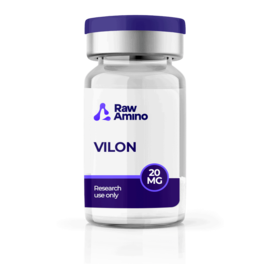

What Is Vilon?
Vilon peptide is one of the more actively studied compounds in immunology and immune research circles within the Khavinson bioregulator family. Also known as Lysylglutamic Acid, Lysylglutamate, or simply KE, it is a dipeptide composed of just two amino acids, lysine and glutamic acid, placing it among the smallest compounds studied in peptide bioregulator science.
As a classified bio-modulator, Vilon is thought to interact with various genetic structures and potentially modify gene expression related to immune cell regulation, proliferation, and differentiation in laboratory settings. Unlike Vesilut, a closely related Khavinson dipeptide we have explored in earlier research overviews, Vilon benefits from a more substantial direct research base — with multiple laboratory studies examining the peptide specifically rather than relying on data from structurally similar compounds. That said, all findings discussed here should be understood as preliminary laboratory observations requiring further investigation before broader conclusions can be drawn.
Chromatin Structure: The Proposed Mechanism
At the foundation of Vilon peptide’s research profile is its proposed ability to interact with chromatin structures within laboratory cell models — a mechanism that researchers have proposed may underpin many of its downstream immune research observations.
Chromatin is the complex of DNA and associated proteins that packages genetic material within the cell nucleus. It exists in two primary functional states: constitutive heterochromatin, which consists largely of non-coding DNA near centromeres and is generally associated with gene silencing, and facultative heterochromatin, which contains condensed regions with genes that are not actively transcribed. The balance between these states plays a central role in determining which genes are expressed in a given cell.
In vitro research by Lezhava et al. suggested that Vilon peptide may induce deheterochromatinization, or the unrolling of total heterochromatin, in cultured lymphocytes in laboratory settings. This process may potentially reactivate ribosomal genes by decondensing nucleolus organizer regions (NORs), which are essential for ribosomal RNA synthesis. Additionally, Vilon appeared to release genes that were repressed due to the condensation of euchromatic regions forming facultative heterochromatin, potentially allowing previously inactive genes to become transcriptionally active in laboratory models.
Importantly, Vilon peptide did not appear to induce decondensation of pericentromeric structural heterochromatin in these models, suggesting its actions may be selective toward facultative heterochromatin. The authors noted that Vilon appears to cause progressive activation of the facultative heterochromatin with increased cellular aging, a finding that has positioned this immunology peptide as an active subject of investigation in cellular aging and gene regulation research.
Previous studies by Sevostianova et al. also posited that Vilon may regulate gene expression and stimulate thymocyte activation in laboratory models, with observed increases in the expression of markers such as HLA-DR and CD54 in thymic cell cultures, as well as normalization of lymphocyte blast-transformation responses considered important for proper immune function.
Vilon Peptide and Immune Cell Proliferation
Building on its proposed chromatin interactions, Vilon peptide has been studied for its potential to stimulate immune cell proliferation in several distinct laboratory model contexts.
Research by Khavinson et al. suggested that Vilon may stimulate the proliferative activity of thymocytes in experimental models exposed to radiation. Histological analyses revealed potential enlargement of thymic lobules, primarily due to widening of the cortical layer, alongside an observed increase in proliferating cell nuclear antigen (PCNA)-positive nuclei within the thymus. The proliferative index in the thymus appeared to increase from approximately 26% to 37% with Vilon exposure in these laboratory models, suggesting better-supported cellular activity in this immune organ.
Research by Ivanov et al. further explored Vilon in a laboratory model of low lymphocyte count due to repeated irradiation, finding that the peptide appeared to normalize lymphocyte numbers compared to control groups where lymphopenia persisted. The Vilon-exposed group also exhibited a higher number of granulocytes compared to intact controls in these laboratory settings.
Khavinson et al. also suggested that Vilon may support the proliferative potential of stem cells in the intestinal epithelium, particularly within the duodenal mucosa. Vilon exposure was associated with a 3.4% increase in the proliferative index in crypt generation zones and a 1.5-fold increase in the number of cells entering mitosis in these laboratory models, suggesting a possible role in supporting gastrointestinal tissue renewal and repair.
Vilon Peptide and Lymphocyte Differentiation
One of the more actively studied dimensions of this immunology peptide’s research profile involves its potential interactions with lymphocyte differentiation processes in laboratory models.
Research by Sevostianova et al. observed that Vilon may induce the differentiation of T-cell precursors toward CD4+ T-helper cells in laboratory settings. Specifically, Vilon appeared to increase the expression of the lymphocyte differentiation marker CD5 in thymic cells, suggesting it might play a role in promoting the differentiation of lymphocyte precursors and potentially facilitating the maturation of thymic cells into functional T-helper cells in laboratory models.
Research by Raikhlin et al. explored Vilon’s potential interactions with argyrophilic proteins within nucleolar organizer regions of thymocytes and epithelial cells in co-culture systems. These proteins are considered integral to ribosome formation and transport, influencing overall protein synthesis within cells. The study reported that Vilon exposure appeared to stimulate the expression of NOR-associated argyrophilic proteins in both cell types, with higher Vilon concentrations correlating with a greater number of silver granules indicative of argyrophilic protein expression. This suggests a possible upregulation of ribosomal biogenesis and protein synthesis capacity in these laboratory models. The researchers also noted a direct mitogenic effect, with Vilon appearing to promote thymocyte transformation into proliferating blast cells in laboratory settings.
Vilon Peptide and Tumor Cell Research
Rounding out this immune research peptide’s broad laboratory profile, Vilon has also been studied for its potential interactions with tumor cell formation in laboratory models, with researchers proposing that these observations may be linked to Vilon’s proposed immunomodulatory properties.
Research by Khavinson et al. reported that Vilon-exposed laboratory models exhibited a potentially lower incidence of pulmonary adenoma cells and mammary adenocarcinoma cells compared to controls in laboratory settings. Researchers proposed that Vilon’s potential immune-supporting properties might contribute to these observations by helping maintain cellular integrity and moderating the accumulation of age-related cellular damage.
Research by Pliss et al. explored Vilon’s potential interactions with preneoplastic and early neoplastic changes in urinary bladder mucosa in laboratory models, observing that Vilon exposure appeared to decrease the occurrence of such changes by approximately twofold. Tumor cell formation was noted in approximately 14.3% of the Vilon group compared to 29.7% in control groups. Researchers proposed that the mechanisms underlying these observations may include immune system stimulation, tissue regeneration support, and moderation of inflammatory processes in laboratory settings, though the precise pathways remain to be fully clarified.
As with all sections of this article, these findings are presented as preliminary laboratory observations. Researchers emphasize that further controlled investigation is needed before broader conclusions can be drawn about Vilon peptide’s interactions across these areas of immune research.
References
- Kazakova TB, et al. In vitro effect of short peptides on expression of interleukin-2 gene in splenocytes. Bull Exp Biol Med. 2002;133(6):614–6.
- National Center for Biotechnology Information. PubChem Compound Summary for CID 7010502, Lysylglutamic acid. 2022.
- Lezhava T, et al. Bioregulator Vilon-induced reactivation of chromatin in cultured lymphocytes from old people. Biogerontology. 2004;5(2):73–9.
- Sevostianova NN, et al. Immunomodulating effects of Vilon and its analogue in the culture of human and animal thymus cells. Bull Exp Biol Med. 2013;154(4):562–5.
- Khavinson VK, Kvetnoii IM. Peptide bioregulators inhibit apoptosis. Bull Exp Biol Med. 2000;130(12):1175–6.
- Ivanov SD, et al. Vilon effect on consequences of repeated radioactive and mercuric impact in small doses. Adv Gerontol. 2005;16:88–91.
- Raikhlin NT, et al. Expression of argyrophilic proteins in the nucleolar organizer regions of human thymocytes and thymic epitheliocytes under conditions of coculturing with Vilon and Epithalon peptides. Bull Exp Biol Med. 2004;137(6):588–91.
- Khavinson VK, et al. Effect of Vilon on biological age and lifespan in mice. Bull Exp Biol Med. 2000;130(7):687–90.
- Pliss GB, et al. Inhibitory effect of peptide Vilon on the development of induced rat urinary bladder tumors. Bull Exp Biol Med. 2001;131(6):558–60.
Disclaimer: The information provided is intended solely for educational and scientific discussion. The compounds described are strictly intended for laboratory research and in-vitro studies only. They are not approved for human or animal consumption, medical use, or diagnostic purposes. Handling is prohibited unless performed by licensed researchers and qualified professionals in controlled laboratory environments.