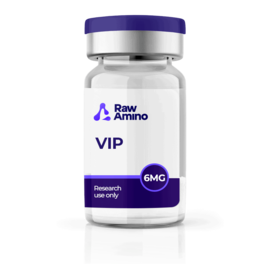
What Is (VIP) Vasoactive Intestinal Peptide?
Vasoactive intestinal peptide, widely recognized in research literature by its abbreviation VIP, is a 28 amino acid peptide originally discovered in 1970 and initially noted for its potential to promote vasodilation. Since its discovery, however, VIP peptide research has expanded considerably, revealing a compound with a surprisingly broad biological profile that extends well beyond its original characterization.
VIP is classified as part of the secretin/glucagon hormone superfamily and appears to be extensively distributed throughout both the central and peripheral nervous systems, as well as in various tissues including the gastrointestinal system. It is thought to interact with two G-protein-coupled receptors, VPAC1 and VPAC2, which are considered part of the secretin receptor family and are proposed to mediate VIP’s wide range of potential interactions in laboratory models. These receptors are understood to enable VIP to mediate overlapping but distinct actions depending on their localization and relative expression in various tissues, making this anti-inflammatory peptide one of the more multifaceted subjects currently under laboratory investigation.
VIP and VPAC Receptor Interactions: The Research Foundation
To understand VIP peptide research across its many research areas, it helps to first understand the two primary receptors through which it is proposed to operate in laboratory models.
Research by Jayawardena et al. explored VPAC1 in depth, reporting that this receptor appears to be primarily found in epithelial cells of gastrointestinal tissues, and is especially abundant in the mucosal and submucosal cells of the colon. Researchers proposed that VPAC1 may play a role in regulating ion transport, mucus secretion, and the maintenance of tight junctions critical for epithelial barrier integrity in laboratory models. VPAC1 may also contribute to the activation of epithelial and mast cells, potentially influencing inflammatory responses by modulating secretion pathways in these models.
Research by Abad et al. revealed that VPAC2 receptors, by contrast, appear to be present primarily in vascular and smooth muscle tissues rather than epithelial cells. These receptors are thought to play a role in VIP-induced relaxation of vascular smooth muscle, contributing to vasodilation in laboratory models. VPAC2 receptors may also be upregulated in activated immune cells such as macrophages and T helper cells, with researchers proposing that VIP activation of VPAC2 may downregulate proinflammatory responses mediated by Th1 and Th17 cells in laboratory settings.
VIP and Inflammation: The Core Anti-Inflammatory Research Profile
At the heart of VIP peptide research is its proposed role as an anti-inflammatory peptide in laboratory models. Research reviewed by Delgado et al. suggested that VIP may potentially inhibit the production of several key pro-inflammatory cytokines, including TNFα, IFNγ, IL-6, and IL-12, while simultaneously potentially supporting the production of anti-inflammatory cytokines including IL-10 and IL-1Ra in laboratory settings.
By interacting with its VPAC1 and VPAC2 receptors, VIP may influence the activity of transcription factors such as NF-κB and AP-1 in laboratory models, potentially leading to altered gene expression of inflammatory mediators. VIP has also been observed to possibly downregulate the production of chemokines and adhesion molecules in experimental settings, potentially reducing the recruitment of inflammatory cells. Researchers have further proposed that VIP may influence the balance between Th1 and Th2 immune responses in laboratory models, possibly shifting toward a Th2 phenotype that may be relevant in research models of autoimmunity where Th1 responses are predominant.
VIP and Intestinal Inflammation Research
Building directly on its anti-inflammatory profile, VIP has also been studied for its potential interactions with intestinal inflammation in laboratory models. Recent research by Sun et al. explored VIP’s proposed role in modulating intestinal barrier function and inflammation through its interactions with regulatory B cells (Bregs) and the anti-inflammatory cytokine IL-10 in laboratory settings.
Bregs are a subset of immune B cells known for their ability to produce IL-10, which researchers consider important for maintaining immune homeostasis. IL-10 from Bregs may suppress excessive inflammatory responses by influencing T helper cell differentiation, potentially promoting a Th2 phenotype while inhibiting Th1 cytokine production. In murine models of colitis induced by dextran sulfate sodium or trinitrobenzene sulfonic acid, VIP exposure appeared to alleviate signs of intestinal inflammation in laboratory models. Researchers proposed that VIP may support IL-10 expression in Bregs, potentially by stabilizing IL-10 mRNA, which might amplify its anti-inflammatory potential in these experimental settings. The researchers commented that VIP appears to play a key role in protecting the colon epithelium from pathogenic bacteria in these experimental models.
VIP and Pancreatic Cell Research
Beyond its immune and inflammatory research profile, VIP has also been studied for its potential interactions with pancreatic cell biology in laboratory models. Research by Hou et al. proposed that VIP might support the process of insulin secretion by pancreatic cells through the cAMP signaling cascade in laboratory settings.
Researchers hypothesized that VIP binding to VPAC2 receptors on pancreatic cells may activate adenylate cyclase, potentially increasing cAMP levels. Elevated cAMP may then activate protein kinase A and exchange proteins directly activated by cAMP, potentially resulting in higher intracellular calcium concentrations and promoting insulin release in laboratory models. Research by Delgado et al. further suggested that VIP may promote pancreatic beta cell proliferation via the FoxM1 pathway, a transcription factor involved in cell cycle progression, potentially supporting beta cell proliferation and insulin secretion in laboratory settings.
VIP and Nerve Cell Survival Research
VIP has also drawn research interest for its potential neuroprotective interactions in laboratory models of neural cell biology. Research by Deng et al. suggested that VIP may have neuroprotective potential linked to its capacity to modulate inflammatory responses within the nervous system. VIP might inhibit the release of proinflammatory cytokines from activated microglial cells in laboratory models, potentially reducing inflammatory processes and indirectly protecting neurons in models of neurodegenerative conditions.
Researchers further proposed that VIP may influence the production of neurotrophic factors including activity-dependent neurotrophic factor (ADNF) and activity-dependent neuroprotective protein (ADNP), which are produced by astrocytes and thought to contribute to neuronal survival in laboratory settings. By potentially influencing ADNF and ADNP levels, VIP may exert an additional neuroprotective dimension in these laboratory models.
VIP and Cardiac Cell Research
Research by Duggan et al. explored VIP’s potential interactions with cardiac tissue in laboratory models, finding that increased VIP levels appeared to be associated with a substantial reduction in myocardial fibrosis relative to baseline levels and controls. Researchers proposed that this potential antifibrotic interaction may involve the modulation of specific profibrotic mediators within heart cells.
Specifically, VIP exposure appeared to selectively reduce the messenger RNA expression of angiotensinogen and angiotensin receptor type 1a in these laboratory models. These components are part of the renin-angiotensin system, which is proposed to play a role in promoting cardiac tissue fibrosis. By potentially downregulating these components, VIP might inhibit local renin-angiotensin activity within heart cells in laboratory settings. VIP is also theorized to exert vasodilatory influence and a possible positive inotropic action in cardiac tissue models, with researchers proposing these mechanisms might further influence fibrotic processes in laboratory settings.
VIP and Vascular Dilation Research
Rounding out this anti-inflammatory peptide’s broad laboratory research profile, VIP has also been studied for its potential interactions with vascular dilation mechanisms in laboratory models. Research by Wilkins et al. indicated that VIP-mediated vasodilation may include a nitric oxide (NO)-dependent component not entirely accounted for by histamine receptor activation. Researchers proposed that VIP might directly stimulate NO production or interact with NO signaling pathways independently of histamine receptors in laboratory settings.
VIP may stimulate the release of histamine from mast cells in laboratory models, potentially leading to vasodilation via activation of H1 histamine receptors alongside increased NO production. The inhibition of NO synthase appeared to contribute to the attenuation of VIP-induced vasodilation in laboratory models, supporting the role of NO in the vasodilatory process. Researchers have proposed that VIP and NO may interact synergistically to support vasodilation in laboratory settings, highlighting the complex and multi-pathway nature of this VIP peptide research subject’s vascular biology profile.
References
- Iwasaki M, Akiba Y, Kaunitz JD. Recent advances in vasoactive intestinal peptide physiology and pathophysiology. F1000Res. 2019;8:F1000 Faculty Rev-1629.
- Jayawardena D, et al. Expression and localization of VPAC1 along the length of the intestine. Am J Physiol Gastrointest Liver Physiol. 2017;313(1):G16–G25.
- Abad C, Tan YV. Immunomodulatory Roles of PACAP and VIP: Lessons from Knockout Mice. J Mol Neurosci. 2018;66(1):102–113.
- Delgado M, et al. Vasoactive intestinal peptide in the immune system: potential therapeutic role in inflammatory and autoimmune diseases. J Mol Med. 2002;80(1):16–24.
- Hou X, et al. Therapeutic potential of vasoactive intestinal peptide and its receptor VPAC2 in type 2 diabetes. Front Endocrinol. 2022;13:984198.
- Deng G, Jin L. The effects of vasoactive intestinal peptide in neurodegenerative disorders. Neurol Res. 2017;39(1):65–72.
- Duggan KA, et al. Vasoactive intestinal peptide infusion reverses existing myocardial fibrosis in the rat. Eur J Pharmacol. 2019;862:172629.
- Wilkins BW, et al. Mechanisms of vasoactive intestinal peptide-mediated vasodilation in human skin. J Appl Physiol. 2004;97(4):1291–8.
- Sun X, et al. Research advances of vasoactive intestinal peptide in the pathogenesis of ulcerative colitis by regulating interleukin-10 expression in regulatory B cells. World J Gastroenterol. 2020;26(48):7593–7602.
Disclaimer: The information provided is intended solely for educational and scientific discussion. The compounds described are strictly intended for laboratory research and in-vitro studies only. They are not approved for human or animal consumption, medical use, or diagnostic purposes. Handling is prohibited unless performed by licensed researchers and qualified professionals in controlled laboratory environments.