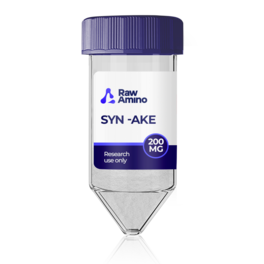
What Is Tripeptide-3 (Syn-AKE)?
Syn-AKE peptide — known scientifically as Tripeptide-3 — is one of the more unusual and fascinating compounds currently being explored in neuromuscular and dermal cell research circles. Its origin story alone sets it apart: Tripeptide-3 is a synthetic compound designed to mimic one specific action of waglerin-1, a peptide found in the venom of the Temple Viper. Rather than replicating the full biological complexity of waglerin-1 — which may interact with multiple biological systems — Tripeptide-3 has been engineered to selectively target just one mechanism: the relaxation of muscle cells through the blocking of acetylcholine receptors at the neuromuscular junction.
Structurally, this skin smoothing peptide is composed of β-alanyl–L-prolyl–3-aminomethyl-L-alanine benzyl amide acetic acid — a carefully designed arrangement that researchers believe allows it to interact selectively with muscular nicotinic acetylcholine receptors (mnAChRs). By targeting only this receptor type — unlike the broader-acting waglerin-1 — Tripeptide-3 offers researchers a more controlled tool for studying how selective acetylcholine receptor blockade influences muscular tissue function in laboratory models. Its primary research focus to date has centered on facial muscle contraction and the appearance of overlying dermal tissue — making it a subject of growing interest in both neuromuscular physiology and wrinkle reduction peptide research.
Nicotinic Acetylcholine Receptors
To understand how Tripeptide-3 works in laboratory settings, it helps to first understand the receptor it targets. Nicotinic acetylcholine receptors (nAChRs) are ion channels that open when the neurotransmitter acetylcholine (ACh) binds to them — allowing ions to flow through and trigger muscle contraction or nerve signaling. Tripeptide-3 appears to interact with these receptors by competing directly with ACh for binding at a specific location called the R-ε interface.
Research building on work by Molles et al. on waglerin-1 suggests that Tripeptide-3 may bind to this interface with stronger affinity than ACh at that specific site — physically blocking ACh from attaching and preventing the receptor’s ion channel from opening. Without this channel opening, the signal transmission process that normally leads to muscle contraction is interrupted in laboratory models.
Researchers have identified specific amino acid residues — including Asp-173, Gly-57, and Tyr-115 — that appear to create a particularly favorable environment for Tripeptide-3 to bind tightly at this site, with Asp-173 playing a especially notable role due to its position within a unique structural feature not found in related proteins. Importantly, research by Munawar et al. and Reddy et al. suggests that this interaction appears to be reversible — if ACh concentrations increase significantly, it may outcompete Tripeptide-3 and displace it from the binding site. This reversibility, combined with its apparent selectivity for muscular nicotinic acetylcholine receptors — without interacting with other receptor types such as GABA receptors — has made this Syn-AKE peptide a particularly clean and controllable research tool in laboratory settings.
Syn-AKE Peptide and Muscle Cell Contractions
With the receptor interaction understood, the downstream effects on muscle cell contractions become clearer. Under normal laboratory conditions, ACh released from nerve cells binds to nicotinic acetylcholine receptors on muscle cells, triggering a conformational change that opens the central ion channel. Sodium ions flow in, potassium ions flow out, and the resulting depolarization — known as the end-plate potential — initiates an action potential that spreads across the entire muscle cell membrane, ultimately triggering contraction.
By blocking ACh from binding to these receptors, Tripeptide-3 may effectively interrupt this entire cascade in laboratory models — preventing the depolarization that would otherwise lead to muscle contraction. The speed and specificity of this effect in laboratory settings has been a particular point of research interest. According to in vitro research by Gorouhi et al., within just two hours of exposure, Tripeptide-3 appeared to reduce the frequency of innervated muscle cell contractions by approximately 82% in laboratory models — a rapid and targeted response that has made this wrinkle reduction peptide a closely watched compound in neuromuscular cell research.
Syn-AKE Peptide and Dermal Topography
Perhaps the most consumer-relevant area of Tripeptide-3 research involves its potential interactions with the appearance of dermal tissue overlying the muscle cells it targets in laboratory models. By apparently reducing muscular tissue contraction in these models, Tripeptide-3 may also influence the topography of the dermal layers above — an observation that has made this skin smoothing peptide a subject of particular interest in dermatological research settings.
In dermal models designed to exhibit wrinkling in the stratum corneum — the outermost layer of skin tissue — Tripeptide-3 appeared to exhibit both immediate and gradually increasing effects on dermal topography over time. Research by Reddy et al. and Pai et al. suggested that the peptide’s observed effects on dermal smoothing may increase with repeated exposure in laboratory models, potentially reaching reductions in wrinkle appearance of more than 50% after four weeks of repeated experimentation. The researchers noted an observed reduction in wrinkle size of up to 52% at a 4% concentration over this period in the laboratory models studied — a finding that has drawn considerable attention in wrinkle reduction peptide research circles, while researchers continue to explore the precise mechanisms involved.
Beyond the topographical changes themselves, researchers have also proposed a secondary effect of interest: by smoothing the dermal surface and minimizing micro-irregularities in the stratum corneum, the barrier function of this outermost layer may become more effective at reducing transepidermal water loss (TEWL) in laboratory models. Wrinkles are thought to compromise the structural integrity of the stratum corneum — and by moderating their formation in dermal cell models, Tripeptide-3 may contribute to a more intact barrier environment. These findings have positioned this Syn-AKE peptide as a multidimensional subject of dermal cell and neuromuscular research — with its combination of receptor-level selectivity and observable effects on dermal tissue models continuing to attract scientific attention in laboratory settings.
References
- Balaev AN, et al. A shortened, protecting group free, synthesis of the anti-wrinkle venom analogue Syn-Ake®. Tetrahedron Letters. 2014;55(42):5745–5747.
- Molles BE, et al. Residues in the epsilon subunit of the nicotinic acetylcholine receptor interact to confer selectivity of waglerin-1. Biochemistry. 2002;41(25):7895–7906.
- Schagen SK. Topical peptide treatments with effective anti-aging results. Cosmetics. 2017;4(2):16.
- Munawar A, et al. Snake venom peptides: Tools of biodiscovery. Toxins. 2018;10(11):474.
- Reddy B, Jow T, Hantash BM. Bioactive oligopeptides in dermatology: Part I. Exp Dermatol. 2012;21(8):563–568.
- Gorouhi F, Maibach HI. Role of topical peptides in preventing or treating aged skin. Int J Cosmet Sci. 2009;31(5):327–345.
- Pai VV, Bhandari P, Shukla P. Topical peptides as cosmeceuticals. Indian J Dermatol Venereol Leprol. 2017;83:9.
- Reddy BY, Jow T, Hantash BM. Bioactive oligopeptides in dermatology: Part II. Exp Dermatol. 2012;21(8):569–575.
Disclaimer: The information provided is intended solely for educational and scientific discussion. The compounds described are strictly intended for laboratory research and in-vitro studies only. They are not approved for human or animal consumption, medical use, or diagnostic purposes. Handling is prohibited unless performed by licensed researchers and qualified professionals in controlled laboratory environments.