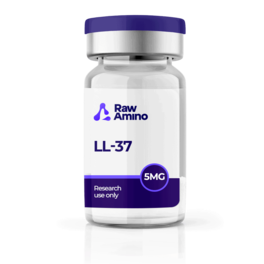
What Is LL-37?
LL-37 peptide is one of the more multifaceted compounds currently being explored across immune peptide research, antimicrobial science, and tissue biology. It belongs to a family of immune-related proteins called cathelicidins — and its name reflects two of its most basic structural features: the first two amino acids in its sequence (Leu–Leu) and its total length of 37 amino acids.LL-37 is derived from a larger precursor protein called hCAP18, which is typically stored in immune cells called neutrophils as well as in various epithelial cells. Once released from these cells, specific enzymes — kallikreins in dermal cells and proteinase 3 in neutrophils — cleave hCAP18’s C-terminal end to generate the active LL-37 peptide. This enzymatic activation process means LL-37 is produced precisely where and when it is needed in biological systems — a design that has fascinated researchers and made it a compelling subject across several areas of immune peptide research.Three broad research areas have emerged as the primary focus of LL-37 laboratory investigation: its potential to disrupt microbial membranes, its modulatory interactions with immune cells, and its potential influence on cell survival, migration, and blood vessel formation in tissue models.
LL-37 Peptide and Microbial Membrane Disruption
At the core of LL-37’s antimicrobial peptide research profile is its proposed ability to interact with and disrupt the membrane structures of microbial organisms in laboratory settings. Research by Turner et al. explored this mechanism in detail — finding that LL-37 may permeabilize both the inner and outer membranes of bacteria such as Escherichia coli ML-35p in laboratory models.Researchers proposed that this membrane-disrupting potential is driven by the peptide’s cationic — or positively charged — structure, which enables electrostatic attraction to the negatively charged surfaces of bacterial membranes. This attraction may allow LL-37 to nestle into or span bacterial membranes — a process potentially facilitated by the peptide’s binding to lipopolysaccharide (LPS), a key component of bacterial outer membranes.Researchers noted that LL-37 appeared to display what is called positive cooperativity in its LPS binding — meaning two LL-37 molecules may interact with each LPS molecule in a mutually reinforcing manner. This cooperative binding may help LL-37 cluster or reorganize bacterial surface elements in ways that support membrane permeabilization in laboratory models.It is worth noting that not all microbial organisms appear equally susceptible to this antimicrobial peptide in laboratory settings. Certain microbes — such as Burkholderia cepacia — appeared to resist LL-37’s membrane-disrupting actions in laboratory assays, possibly due to outer membrane modifications that limit the peptide’s access or insertion. Researchers also highlighted an important technical consideration: certain standard laboratory broths containing polyanionic components appeared to reduce LL-37’s observed activity, likely by sequestering or precipitating the cationic peptide — underscoring the importance of careful experimental design in this area of immune peptide research.Beyond bacterial membranes, some studies have also suggested that this LL-37 peptide may exhibit activity against enveloped viruses such as HSV-1 and vaccinia virus, and may inhibit certain non-enveloped viruses through different mechanisms — adding a further dimension to its antimicrobial research profile that continues to be investigated in laboratory settings.
LL-37 Peptide and Immune Cell Modulation
Beyond its direct antimicrobial interactions, LL-37 has also been extensively studied for its potential to modulate immune cell behavior in laboratory models — an area that has become one of the most active fronts in LL-37 immune peptide research.Research by Sadek et al. explored how LL-37 may influence neutrophils — a key type of immune cell — when exposed to microbial stimuli in vitro. The findings suggested that LL-37 may increase the production of reactive oxygen species (ROS) in neutrophils through mechanisms linked to the respiratory burst — the process by which phagocytic cells consume large amounts of oxygen to help destroy pathogens. LL-37 also appeared to play a role in augmenting the engulfment of bacteria during phagocytosis in these laboratory models — potentially contributing to the microbicidal capabilities of neutrophils.Researchers studying cathelicidin-deficient murine models also observed that without this peptide, neutrophils appeared to release more TNF-α upon bacterial stimulation while showing lower bactericidal capacity compared to controls — suggesting that LL-37 may help fine-tune the balance between pathogen killing and the control of excessive inflammatory signaling in laboratory immune cell models.Research by Takahashi et al. added another layer to this immune modulation picture — suggesting that LL-37 might also activate immune cells by interacting with scavenger receptors on their surface, potentially mediating their interaction with regulatory molecules like self-RNA. This interaction appeared to enable self-RNA to activate intracellular pathways leading to cytokine production — including interleukin-6 and interferon-β1 — in laboratory models. Blocking these scavenger receptors significantly reduced cytokine production in the same models, suggesting a receptor-dependent mechanism.Perhaps most interestingly, research by Kusaka et al. suggested that once LL-37 disrupts microbial structures like LPS, it may subsequently help reduce proinflammatory signaling — potentially limiting collateral inflammatory damage in laboratory tissue models. The disruption of LPS by LL-37 was followed by diminished induction of key proinflammatory mediators including IL-6 and IL-8 — suggesting that this antimicrobial peptide may play a dual role in laboratory models, both engaging the immune response and helping to moderate it once the initial threat has been addressed.
Blood Vessel Formation
Moving beyond immune modulation, LL-37 has also drawn research interest for its potential interactions with blood vessel formation — or angiogenesis — in laboratory cell models. Research by Salvador et al. proposed that LL-37 may act as a multifunctional compound that induces a blood vessel-promoting response in endothelial cells through a pathway involving prostaglandin E2 (PGE2).In laboratory models, LL-37 appeared to trigger PGE2 synthesis in endothelial cells in a concentration-dependent manner — with maximal induction observed after approximately four hours of exposure. Researchers proposed that this occurs through a cascade involving increased intracellular calcium levels and activation of cytosolic phospholipase A2 (cPLA2) — ultimately releasing arachidonic acid that feeds cyclooxygenase activity and PGE2 production.Interestingly, while both COX-1 and COX-2 enzymes were present in the endothelial cells studied, COX-1 appeared to play the primary role in generating LL-37-induced PGE2 in these laboratory models. Blocking COX-1 function appeared to abolish the PGE2 increase — and also diminished the cord-like structures formed by endothelial cells in the presence of LL-37, which researchers use as a laboratory indicator of angiogenic activity. Adding PGE2 back into the system appeared to rescue this angiogenic response — suggesting that LL-37’s capacity to promote endothelial tubule formation in laboratory models is at least partly mediated through COX-1-derived PGE2 acting on EP3 receptors.
LL-37 Peptide and Wound Tissue Repair
Building on its proposed angiogenic properties, LL-37 has also been studied for its potential role in wound tissue repair in laboratory models. Research by Ramos et al. explored LL-37’s potential in this context — finding that the peptide may stimulate proliferation, migration, and tubule-like structure formation in endothelial cell lines in vitro. These observations led researchers to propose that LL-37 may contribute to angiogenesis-related processes relevant to tissue repair, potentially mediated through a receptor called FPRL-1.In a laboratory wound healing model compromised by dexamethasone — a compound commonly used in research settings to impair the normal repair process — LL-37 appeared to support re-epithelialization and promote the appearance of blood vessels in the wound area. Researchers proposed that this LL-37 peptide’s combination of immunomodulatory and proangiogenic properties may help overcome the suppressive effects of glucocorticoid compounds on tissue regeneration in laboratory settings — though the precise pathways involved remain an active area of immune peptide research.
LL-37 Peptide and Cancer Cell Research
One of the more nuanced and carefully studied areas of LL-37’s research profile involves its potential interactions with cancer cells in laboratory settings. Research by Lu et al. explored a range of mechanisms through which LL-37 may interact with cancer cell lines in vitro — finding a complex and context-dependent picture that researchers continue to investigate.In some cancer cell line models, LL-37 appeared to trigger cell death through a non-membranolytic, receptor-linked mechanism potentially involving G protein-coupled receptors. Researchers observed that the peptide may modulate intracellular pathways associated with proteins including p53, Bcl-2, and Bax — potentially upregulating pro-apoptotic effectors while downregulating anti-apoptotic proteins in these specific laboratory models. Researchers also proposed that LL-37 might regulate intracellular protein degradation pathways by inhibiting proteasome function — potentially leading to the accumulation of tumor-suppressive signals and cell cycle arrest in laboratory models.However — and this is an important nuance in this area of immune peptide research — LL-37’s potential interactions with cancer cells do not appear to be universally inhibitory across all laboratory models. Other researchers have reported observations where LL-37 appeared to promote proliferation in some tumor cell lines, possibly through Wnt/β-catenin signaling or by influencing NF-κB pathways. Why this antimicrobial peptide may produce opposing outcomes in different experimental cancer models remains an open and actively debated question in the research community — with no definitive explanation yet established.
References
- Kahlenberg JM, Kaplan MJ. Little peptide, big effects: the role of LL-37 in inflammation and autoimmune disease. J Immunol. 2013;191(10):4895–901.
- Seil M, et al. Spotlight on Human LL-37, an Immunomodulatory Peptide with Promising Cell-Penetrating Properties. Pharmaceuticals. 2010;3(11):3435–60.
- Gordon YJ, et al. Human cathelicidin (LL-37), a multifunctional peptide, is expressed by ocular surface epithelia. Curr Eye Res. 2005;30(5):385–94.
- Turner J, et al. Activities of LL-37, a cathelin-associated antimicrobial peptide of human neutrophils. Antimicrob Agents Chemother. 1998;42(9):2206–14.
- Alalwani SM, et al. The antimicrobial peptide LL-37 modulates the inflammatory and host defense response of human neutrophils. Eur J Immunol. 2010;40(4):1118–26.
- Takahashi T, et al. Cathelicidin promotes inflammation by enabling the binding of self-RNA to cell surface scavenger receptors. Sci Rep. 2018;8(1):4032.
- Kusaka S, et al. Expression of human cathelicidin peptide LL-37 in inflammatory bowel disease. Clin Exp Immunol. 2018;191(1):96–106.
- Salvador MD, et al. Cathelicidin LL-37 induces angiogenesis via PGE2-EP3 signaling in endothelial cells. Arterioscler Thromb Vasc Biol. 2013;33(8):1965–72.
- Ramos R, et al. Wound healing activity of the human antimicrobial peptide LL37. Peptides. 2011;32(7):1469–76.
- Lu F, et al. Renovation as innovation: Repurposing human antibacterial peptide LL-37 for cancer therapy. Front Pharmacol. 2022;13:944147.
Disclaimer: The information provided is intended solely for educational and scientific discussion. The compounds described are strictly intended for laboratory research and in-vitro studies only. They are not approved for human or animal consumption, medical use, or diagnostic purposes. Handling is prohibited unless performed by licensed researchers and qualified professionals in controlled laboratory environments.