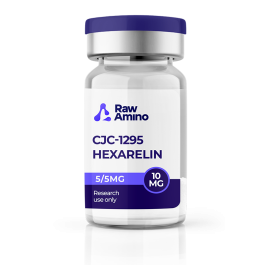

What Is CJC-1295 DAC?
CJC-1295 DAC peptide is one of the more structurally distinctive compounds currently being explored in long-acting GHRH peptide and growth hormone releasing peptide research. It is a synthetic analog of growth hormone-releasing hormone (GHRH), composed of 29 amino acids, and represents the shortest functional analog of GHRH that appears to retain the potential to stimulate growth hormone release from somatotroph cells in the pituitary gland in laboratory models.
What sets CJC-1295 DAC apart from other GHRH analogs in research settings is the addition of its Drug Affinity Complex (DAC) component. While naturally occurring GHRH has a half-life of approximately 7 minutes, and CJC-1295 without DAC extends this to approximately 30 minutes through its amino acid substitutions, the integration of DAC technology is believed to extend the half-life of CJC-1295 DAC to approximately 6 to 8 days in laboratory settings. This extended activity has made CJC-1295 DAC a particularly active subject of growth hormone releasing peptide research compared to its shorter-acting counterparts.
The DAC Technology: What Makes This GHRH Peptide Unique
To understand what differentiates CJC-1295 DAC from other GHRH analogs, it helps to understand both the amino acid substitutions and the DAC component that together define this long-acting GHRH peptide’s structural profile.
CJC-1295 DAC incorporates four amino acid substitutions compared to endogenous GHRH, each serving a distinct purpose in laboratory settings. At position 2, L-alanine is replaced with D-alanine to potentially increase resistance against enzymatic degradation. At position 8, asparagine is replaced with glutamine to reduce the likelihood of asparagine rearrangement and amide hydrolysis. At position 15, glycine is replaced with alanine, theorized to enhance bioactivity. At position 27, methionine is replaced with leucine to potentially prevent methionine oxidation in laboratory conditions.
Beyond these substitutions, the DAC component involves attaching a lysine derivative, N-epsilon-3-maleimidopropionamide, to the C-terminus of the peptide. This modification is thought to allow CJC-1295 DAC to bind to plasma proteins in laboratory models, substantially extending its circulation time compared to both endogenous GHRH and CJC-1295 without DAC. Researchers proposed that this extended half-life maintains a significant affinity for GHRH receptors in laboratory models, making this growth hormone releasing peptide a particularly useful research tool for studying prolonged GH stimulation in controlled experimental environments.
CJC-1295 DAC Peptide and Growth Hormone Regulation Research
Two pivotal clinical studies conducted in 2006 explored the influence of CJC-1295 DAC in laboratory research models, providing some of the most detailed mechanistic data available for this long-acting GHRH peptide. The first study used CJC-1295 DAC at four ascending concentrations, while the second involved repeated exposure at a single concentration. Results from Teichman et al. indicated an apparent increase in both growth hormone and IGF-1 levels following CJC-1295 DAC exposure in these laboratory settings.
Researchers proposed that CJC-1295 DAC may interact with binding sites on the GHRH receptor protein, initiating molecular processes that activate intracellular G-proteins in laboratory models. These proteins may promote the production of secondary messengers like cAMP, considered crucial in cellular signaling pathways. The activation of protein kinases by these messengers might lead to the phosphorylation of transcription regulators, potentially influencing gene expression involved in growth hormone production in these experimental settings.
CJC-1295 DAC Peptide and GH and IGF-1 Levels
One of the most closely observed aspects of CJC-1295 DAC peptide research involves its proposed influence on growth hormone and IGF-1 levels in laboratory models. Initial exposure in experimental models appeared to produce a significant increase in average growth hormone levels, reportedly by 2 to 10-fold for up to 6 days in these settings. IGF-1 levels appeared to rise by 1.5 to 3-fold for approximately 9 to 11 days, with elevated levels potentially lasting at least two weeks in laboratory conditions.
Research by Ionescu and Frohman further suggested that a single exposure to CJC-1295 DAC may be associated with a 50% increase in mean growth hormone secretion and IGF-1 levels in laboratory models. Repeated exposure appeared to maintain elevated IGF-1 levels above baseline for up to 28 days in laboratory settings, suggesting a potentially cumulative interaction. Researchers proposed that CJC-1295 DAC may elevate IGF-1 levels by stimulating growth hormone production, which may bind to receptors on liver cells and activate the JAK-STAT pathway, potentially leading to IGF-1 gene transcription and the transport of produced IGF-1 to various target tissues in laboratory models.
CJC-1295 DAC Peptide and Animal-Based Research
Further laboratory research using murine models explored the potential of CJC-1295 DAC across several cellular and physiological parameters. Research by Alba et al. suggested that daily exposure appeared to normalize growth in laboratory models, while less frequent exposure produced intermediate results, suggesting an interval-dependent interaction in these experimental settings. The study also indicated that CJC-1295 DAC may influence mass composition in laboratory models by potentially increasing muscle tissue hypertrophy while reducing fat tissue levels. In GHRHKO murine models, CJC-1295 DAC exposure appeared to preserve normal lean mass levels and maintain subcutaneous fat mass consistent with control levels. Researchers noted that immunohistochemistry images suggested CJC-1295 DAC caused an increase in total pituitary RNA and GH mRNA in laboratory models, proposing that proliferation of somatotroph cells may have occurred in these experimental settings.
CJC-1295 DAC Peptide and Reproductive Research
Rounding out this growth hormone releasing peptide’s research profile, earlier laboratory studies from the 1990s explored CJC-1295 and other GHRH analogs in the context of ovulation research in laboratory models. Research by Volpe et al. suggested that GRF analogs may promote ovulation in laboratory models, with researchers noting a significant increase in both follicular fluid IGF-1 levels and plasma growth hormone levels in the experimental models studied. Researchers proposed that ovulation may be dependent on IGF-1 and likely influenced by growth hormone release and cycling in laboratory settings, with GH and IGF-1 levels appearing to increase significantly around the time of ovulation in animal models of superovulation. These findings positioned growth hormone secretagogues including CJC-1295 as subjects of interest in reproductive biology laboratory research, adding a further dimension to this long-acting GHRH peptide’s broad research profile.
References
- Henninge J, et al. Identification of CJC-1295, a growth-hormone-releasing peptide, in an unknown pharmaceutical preparation. Drug Test Anal. 2010;2(11-12):647–50.
- Jetté L, et al. Human GRF1-29-albumin bioconjugates activate the GRF receptor on the anterior pituitary in rats. Endocrinology. 2005;146(7):3052–8.
- Sinha DK, et al. Beyond the androgen receptor: the role of growth hormone secretagogues. Transl Androl Urol. 2020;9(S2):S149–S159.
- Van Hout MC, Hearne E. Netnography of Female Use of the Synthetic Growth Hormone CJC-1295. Subst Use Misuse. 2016;51(1):73–84.
- Teichman SL, et al. Prolonged stimulation of growth hormone and IGF-1 secretion by CJC-1295. J Clin Endocrinol Metab. 2006;91(3):799–805.
- Ionescu M, Frohman LA. Pulsatile secretion of growth hormone persists during continuous stimulation by CJC-1295. J Clin Endocrinol Metab. 2006;91(12):4792–7.
- Martin B, et al. Class II G protein-coupled receptors and their ligands in neuronal function and protection. Neuromolecular Med. 2005;7(1-2):3–36.
- Alba M, et al. Once-daily administration of CJC-1295 normalizes growth in the GHRH knockout mouse. Am J Physiol Endocrinol Metab. 2006;291(6):E1290–4.
- Volpe A, et al. Clinical use of growth hormone-releasing factor for induction of superovulation. Hum Reprod. 1991;6(9):1228–32.
Disclaimer: The information provided is intended solely for educational and scientific discussion. The compounds described are strictly intended for laboratory research and in-vitro studies only. They are not approved for human or animal consumption, medical use, or diagnostic purposes. Handling is prohibited unless performed by licensed researchers and qualified professionals in controlled laboratory environments.