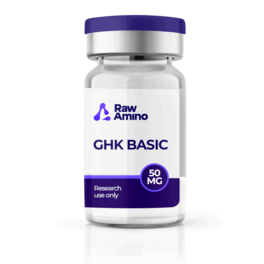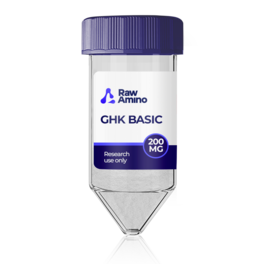
What Is GHK Basic?
GHK Basic is one of the more intriguing antioxidant peptides currently being explored in biochemical research circles. Composed of just three amino acids — glycine, histidine, and lysine — this compact tripeptide mirrors a sequence found naturally in biological samples including blood plasma, urine, and saliva. It is biosynthesized or chemically produced to match the endogenous GHK tripeptide, which is believed to be secreted or released by a variety of cell types, including fibroblasts, lymphocytes, and macrophages.
What makes GHK Basic particularly interesting to researchers is its strong propensity to bind copper ions (Cu²⁺), forming what is known as a GHK-copper complex. This copper-binding capability is thought to allow the peptide to interact with a wide range of biological targets — from ion channels and enzymes to cell-surface receptors and gene expression pathways. Researchers have proposed that this GHK copper peptide may play a meaningful role in processes related to tissue repair, collagen synthesis, and — most prominently in recent research — the modulation of oxidative stress and inflammation in laboratory models.
GHK Basic as an Antioxidant Peptide: Scavenging Reactive Aldehydes
One of the most compelling areas of GHK Basic research involves its potential behavior as an antioxidant peptide — specifically its apparent ability to neutralize highly reactive and potentially damaging molecules before they can cause cellular harm in laboratory settings.
Research by Cebrián et al. evaluated GHK Basic against two well-known reactive aldehydes that tend to accumulate in UV-exposed dermal tissue: 4-hydroxy-2-nonenal (HNE) and acrolein. In laboratory conditions, when either aldehyde was combined with GHK Basic, the concentration of free aldehyde — and the protein-damaging compounds it normally produces — dropped markedly. Researchers described this as the peptide essentially “”sacrificing”” itself, binding these reactive molecules before they could attack dermal proteins in the experimental models.
When compared to carnosine — a well-studied aldehyde scavenger — GHK Basic appeared slightly less potent against HNE but more effective at neutralizing acrolein. Researchers attributed this difference to the way the peptide’s histidine and lysine components interact with different aldehyde structures — a finding that highlights the structural specificity of this collagen repair peptide’s antioxidant behavior.
This protective chemistry also extended to enzyme models of sugar-driven cellular damage. When the antioxidant enzyme superoxide dismutase (SOD) was exposed to fructose — a process that typically reduces its activity to around 40% of normal through glycation — adding GHK Basic appeared to restore most of the lost enzyme activity. Researchers suggested the peptide may intercept early carbonyl intermediates before they can attach to and damage SOD, preserving its function in laboratory conditions.
GHK Basic and Glutathione Preservation in Cell Models
The antioxidant potential of this GHK copper peptide extends beyond direct radical scavenging. Research by Cebrián et al. also examined how GHK Basic interacts with glutathione (GSH) — one of the cell’s most important internal antioxidant defenses — under UV stress conditions in laboratory cell models.
Under UVB exposure, keratinocytes typically detoxify HNE by coupling it with glutathione. However, even moderate UVB doses can deplete GSH reserves, leaving cells increasingly vulnerable to further oxidative damage. In laboratory models where additional HNE was introduced under these UVB conditions, large areas of the cell layer were destroyed. However, when cells were pre-exposed to GHK Basic, the monolayer appeared to remain largely intact, and the amount of HNE-GSH conjugate produced was notably reduced.
Researchers interpreted this as evidence that GHK Basic may neutralize reactive aldehydes directly — effectively stepping in ahead of glutathione and preserving the cell’s limited GSH supply for other defensive functions. This glutathione-sparing behavior has made GHK Basic a subject of considerable interest among researchers studying oxidative stress responses in dermal cell models.
GHK Basic and Iron-Mediated Oxidative Stress
Another dimension of GHK Basic’s antioxidant research profile involves its potential interactions with iron — a metal that, when released from damaged tissue, can drive particularly aggressive forms of oxidative stress through a process known as Fenton chemistry.
Research by Miller et al. suggested that GHK Basic may bind to the channels of ferritin — a protein responsible for iron storage — and physically reduce the release of iron ions by approximately 87% in laboratory models. By limiting the availability of free iron, the peptide may help suppress the chain of oxidative reactions that free iron can trigger in damaged tissue environments.
Complementing this finding, research by Sakuma et al. suggested that GHK Basic may also directly scavenge two of the most aggressive oxidants encountered in biological systems: hydroxyl radicals (·OH) and tert-butyl-peroxyl radicals (ROO·). In laboratory evaluations, the peptide appeared to reduce hydroxyl radical signals by approximately 47% and peroxyl radical signals by roughly 30%. Notably, its hydroxyl radical-quenching capacity was suggested to exceed that of both carnosine and glutathione under the same experimental conditions.
Researchers also observed that a simple mixture of the three individual amino acids — glycine, histidine, and lysine — did not appear to replicate these protective effects, suggesting that it is the specific geometry of the assembled tripeptide — and possibly its metal-chelating structure — that creates this antioxidant activity, rather than the individual components acting independently.
GHK Basic and Inflammatory Signaling in Laboratory Models
Perhaps the most striking recent research on this antioxidant peptide involves its potential influence on inflammatory signaling pathways in laboratory cell models. Research by Park et al. explored what happens when GHK Basic is introduced to macrophages — immune cells that typically produce a burst of reactive oxygen species (ROS) and pro-inflammatory signaling molecules when challenged with bacterial antigens in laboratory settings.
In these experiments, adding GHK Basic appeared to largely reverse the expected inflammatory response: intracellular ROS levels fell, SOD activity returned toward normal levels, and the typical spike in pro-inflammatory cytokines such as TNF-α and IL-6 was significantly reduced. Researchers traced these effects to two key inflammatory pathways. First, the peptide appeared to prevent the transcription factor NF-κB p65 from entering the cell nucleus — effectively blocking a critical molecular switch that drives inflammatory gene expression. Second, GHK Basic appeared to dial down activation of the p38 MAP-kinase pathway, and to a lesser extent JNK, while leaving the ERK branch unaffected.
In tissue models exposed to bacterial challenge, GHK Basic was associated with stronger antioxidant defenses — including higher SOD activity and elevated glutathione levels — alongside markedly lower concentrations of TNF-α and IL-6. The tissue models also displayed fewer infiltrating neutrophils, reduced myeloperoxidase activity, and less protein leakage — all indicators of a more contained inflammatory response in the laboratory setting. The researchers noted that the peptide appeared to suppress the infiltration of inflammatory cells into lung tissue models, suggesting that GHK copper peptide may help moderate the cascade of cellular events that typically follows bacterial exposure in controlled experimental environments.
A Brief Note on Tissue Repair and Collagen Synthesis
While the antioxidant and anti-inflammatory research represents the primary focus of this article, it is worth briefly noting that GHK Basic has also been studied in the context of tissue repair and collagen synthesis — areas covered in greater depth in related research literature. Research by Mulder et al. observed approximately 98% tissue recovery in laboratory models exposed to GHK Basic following debridement, compared to 61% in controls. Research by Maquart et al. suggested that fibroblasts exposed to the GHK copper peptide appeared to increase their output of type I collagen — a finding the authors linked to a GHK motif found within the collagen molecule itself, which may be liberated during tissue breakdown and act as a local repair signal.
For researchers interested in exploring the full scope of GHK Basic’s studied interactions with collagen and connective tissue, these findings provide important additional context for understanding the peptide’s broader research profile.
References
- Mulder GD, et al. Enhanced healing of ulcers by topical treatment with glycyl-l-histidyl-l-lysine copper. Wound Repair Regen. 1994;2(4):259–269.
- Canapp SO Jr, et al. The effect of topical tripeptide-copper complex on the healing of ischemic open wounds. Veterinary Surgery. 2003;32(6):515–523.
- Maquart FX, et al. Stimulation of collagen synthesis in fibroblast cultures by the tripeptide-copper complex GHK-Cu2+. FEBS Letters. 1988;238(2):343–346.
- Cebrián J, et al. New anti-RNS and -RCS products for cosmetic treatment. Int J Cosmet Sci. 2005;27(5):271–278.
- Miller TR, et al. Effects of topical copper tripeptide complex on CO2 laser-resurfaced skin. Arch Facial Plast Surg. 2006;8(4):252–259.
- Sakuma S, et al. The peptide GHK is an endogenous antioxidant in living organisms. Int J Physiol Pathophysiol Pharmacol. 2018;10(3):132–138.
- Park JR, et al. The tri-peptide GHK-Cu complex ameliorates lipopolysaccharide-induced acute lung injury in mice. Oncotarget. 2016;7(36):58405–58417.
Disclaimer: The information provided is intended solely for educational and scientific discussion. The compounds described are strictly intended for laboratory research and in-vitro studies only. They are not approved for human or animal consumption, medical use, or diagnostic purposes. Handling is prohibited unless performed by licensed researchers and qualified professionals in controlled laboratory environments.