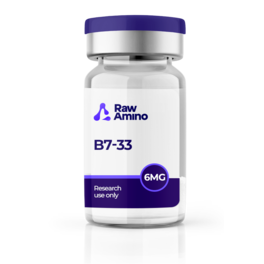

What Is B7-33?
B7-33 peptide is one of the more structurally distinctive compounds currently being explored in relaxin analog peptide and anti-fibrotic peptide research circles. It is a single-chain peptide synthesized in a soluble form and derived from the naturally occurring protein H2-relaxin, a member of the relaxin family of proteins considered to demonstrate diverse biological actions including gene regulation and influences on reproductive, musculoskeletal, and cardiovascular systems in laboratory research contexts.
What makes this relaxin analog peptide particularly interesting from a research standpoint is its proposed ability to replicate the anti-fibrotic properties of H2-relaxin through a distinct molecular pathway. Research by Hossain et al. noted that H2-relaxin typically activates the cAMP pathway, which may stimulate the formation of tumors in laboratory models, representing a significant liability in relaxin research contexts. B7-33 was developed to potentially exhibit the proposed anti-fibrotic interactions of H2-relaxin without activating cAMP in laboratory settings, instead appearing to activate the pERK pathway through its strong affinity for RXFP-1 receptors. This mechanistic distinction has made B7-33 one of the more compelling subjects of anti-fibrotic peptide research in controlled laboratory environments.
Proposed Mechanism: The pERK Pathway
To understand what sets this relaxin analog peptide apart from its parent molecule in laboratory research, it helps to appreciate the two distinct molecular pathways involved in their proposed interactions. H2-relaxin typically activates the cAMP pathway in laboratory models, which while potentially anti-fibrotic, may also stimulate the formation of tumors in these settings, limiting its research utility in certain contexts.
Research by Hossain et al. suggested that this relaxin analog peptide may activate the pERK pathway instead, potentially resulting in increased synthesis of MMP-2 matrix metalloproteinase in laboratory models. These enzymes are considered to inhibit the scarring of tissues in laboratory research contexts and may serve as preventative agents in the onset of fibrosis in these settings. By potentially binding to RXFP-1 receptors and activating the pERK pathway rather than cAMP in laboratory models, B7-33 may offer a more targeted approach to anti-fibrotic peptide research without the tumor-stimulating concerns associated with its parent molecule in these experimental settings.
B7-33 Peptide and Vasoprotection Research
At the core of B7-33 relaxin analog peptide research is its proposed vasoprotective interactions in laboratory models. Research by Marshall et al. investigated B7-33 in male Wistar rat laboratory models, assessing vasculature functions in the mesenteric artery, renal artery, and abdominal aorta following exposure to either a placebo, H2-relaxin, or B7-33 peptide. Both B7-33 and H2-relaxin appeared to cause improvement in the vasodilatory properties of the mesenteric artery in these laboratory settings, with researchers noting that B7-33 replicated the acute beneficial vascular interactions of serelaxin in rat mesenteric arteries in these models.
A further laboratory study in female mice with experimentally induced endothelial dysfunction suggested that both B7-33 and H2-relaxin may have potentially moderated and prevented the further spread of endothelial dysfunction in these experimental settings. Researchers proposed that B7-33 should be considered a cost-effective vasoactive research compound for cardiovascular laboratory investigations, given its proposed ability to replicate H2-relaxin’s vascular interactions through a more accessible synthetic process in laboratory settings.
Preeclampsia Research
Building on its vasoprotection research profile, B7-33 has also been studied for its potential interactions with preeclampsia-related cellular models in laboratory settings. Research by Afroze et al. conducted an in vitro study using cell cultures of cytotrophoblasts, cells found in the inner cellular layer of the embryo, to explore B7-33’s potential interactions in laboratory models of preeclampsia-related pathology.
The study suggested that this peptide may possibly increase vascular endothelial growth factor levels in all cell types studied in these laboratory settings. Researchers noted that a relaxin antagonist appeared to decrease VEGF concentrations in these cells, suggesting the interactions were mediated through relaxin receptor pathways in laboratory models. Researchers proposed that B7-33 and its derivatives may potentially counteract excessive glucose and marinobufagenin levels in laboratory cellular models, with all findings carefully framed as preliminary in vitro observations requiring further controlled investigation before broader conclusions can be drawn.
B7-33 Peptide and Anti-Fibrosis Research
Rounding out this relaxin analog peptide’s broad laboratory research profile, B7-33 has also been extensively studied for its proposed anti-fibrotic interactions across multiple tissue types in laboratory models. Research suggested that when introduced to laboratory mice with simulated myocardial infarction, B7-33 peptide appeared to induce a nearly 50% reduction in cardiac tissue fibrosis and improved heart function in these experimental settings. Researchers attributed this to the peptide’s potential to increase the concentration of matrix metalloproteinase protein in laboratory models, which is proposed to counteract collagen-damaging processes and prevent fibrosis in these settings.
Additionally, research in laboratory mice with prostate cancer cell models suggested that this peptide may have contributed to moderating fibrosis and tumor spreading in these experimental settings. Researchers proposed that the peptide appeared to act exclusively via the pERK pathway in laboratory models, potentially moderating cell spread without activating cAMP in these settings. This dual anti-fibrotic profile across both cardiac and prostate cancer cell laboratory models has positioned B7-33 as one of the more versatile anti-fibrotic peptide research subjects currently under investigation in controlled laboratory environments.
References
- Summers RJ. Recent progress in the understanding of relaxin family peptides and their receptors. Br J Pharmacol. 2017;174(10):915–920.
- Patil NA, et al. Relaxin family peptides: structure-activity relationship studies. Br J Pharmacol. 2017;174(10).
- Hossain MA, et al. A single-chain derivative of the relaxin hormone is a functionally selective agonist of the G protein-coupled receptor, RXFP1. Chem Sci. 2016;7(6):3805–3819.
- Marshall SA, et al. B7-33 replicates the vasoprotective functions of human relaxin-2 (serelaxin). Eur J Pharmacol. 2017;807:190–197.
- Afroze SH, et al. Novel Peptide B7-33 and Its Lipidated Derivative Protect Cytotrophoblasts From Preeclampsia Phenotype. Hypertension. 2019;74(suppl_1):P3042.
- Silvertown JD, et al. H2 relaxin overexpression increases in vivo prostate xenograft tumor growth and angiogenesis. Int J Cancer. 2006;118(1):62–73.
- Feng S, et al. Relaxin Promotes Prostate Cancer Progression. Clin Cancer Res. 2007;13(6):1695.
- Welch N, et al. Coatings Releasing the Relaxin Peptide Analogue B7-33 Reduce Fibrotic Encapsulation. ACS Appl Mater Interfaces. 2019.
Disclaimer: The information provided is intended solely for educational and scientific discussion. The compounds described are strictly intended for laboratory research and in-vitro studies only. They are not approved for human or animal consumption, medical use, or diagnostic purposes. Handling is prohibited unless performed by licensed researchers and qualified professionals in controlled laboratory environments.