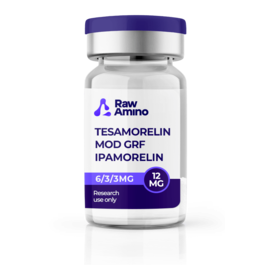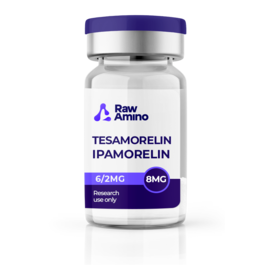
What Is the Tesamorelin and Ipamorelin Blend?
The Tesamorelin and Ipamorelin peptide blend consists of two synthetic compounds that have attracted considerable scientific interest for their potential to interact with pituitary gland cells and stimulate growth hormone synthesis in laboratory settings. What makes this growth hormone secretagogue peptide combination particularly compelling to researchers is that each compound appears to operate through a distinct and potentially complementary pathway, making their combination a subject of active synergistic research.
Tesamorelin is a synthetic peptide that mimics the structure and actions of native growth hormone-releasing hormone (GHRH), sharing its 44 amino acid structure with a specific modification at each terminus. Research by Ferdinandi et al. suggested that this modification may support the peptide’s affinity for GHRH receptors and its resistance to degradation in laboratory settings, potentially prolonging receptor activation. Research by González-Sales et al. further indicated that somatotroph cells in the pituitary generally begin increasing growth hormone production within 30 to 60 minutes of Tesamorelin exposure in laboratory models.
Ipamorelin, meanwhile, is a synthetic peptide that interacts with growth hormone secretagogue receptors (GHS-Rs) on pituitary cells. These are also receptors for the native hormone ghrelin, commonly referenced in research as the hunger hormone. Research by Raun et al. highlighted that Ipamorelin appears more selective in its receptor activation compared to predecessor compounds in its class, potentially influencing growth hormone synthesis without significantly interacting with other pituitary hormones such as ACTH or prolactin in laboratory models.
Pituitary Cell Receptor Interactions
Both Tesamorelin and Ipamorelin appear to interact with receptors on the anterior pituitary gland, though through distinct molecular pathways that have made their combination a subject of particular research interest in growth hormone secretagogue peptide science.
Research by Spooner et al. and Zhou et al. suggested that Tesamorelin’s binding to GHRH receptors induces a notable conformational shift involving transmembrane helix 6, exposing the intracellular side for G protein coupling. This may activate the enzyme adenylate cyclase, converting ATP into cAMP. Elevated cAMP levels may then activate protein kinase A (PKA), leading to protein phosphorylation and amplification of GHRH receptor signaling, ultimately stimulating the synthesis and secretion of growth hormone from somatotroph cells in laboratory models.
Ipamorelin operates differently. Research by Jiménez-Reina et al. suggested that by binding to GHS receptors, Ipamorelin may activate phospholipase C (PLC), leading to the production of IP3 and diacylglycerol (DAG). IP3 may trigger the release of calcium ions from intracellular stores, while DAG activates protein kinase C (PKC). The resulting rise in intracellular calcium and PKC activation collectively support growth hormone vesicle exocytosis from pituitary cells in laboratory settings.
Tesamorelin and Ipamorelin: Synergistic Potential in Laboratory Models
The distinct receptor pathways through which Tesamorelin and Ipamorelin operate have led researchers to investigate whether combining them may yield synergistic effects on growth hormone secretion, potentially surpassing what either compound could achieve independently.
Research by Stanley et al. observed that Tesamorelin may increase overall growth hormone production by somatotroph cells by approximately 69% in laboratory models, as measured by the 12-hour area under the curve. The average pulse area of growth hormone was observed to increase by approximately 55%, while levels of insulin-like growth factor 1 (IGF-1) rose by approximately 122% in the same models. Research by Gobburu et al. suggested that Ipamorelin may elevate growth hormone secretion levels to approximately 80 mIU/L in laboratory models, representing roughly a 60-fold increase compared to placebo conditions.
A literature review by Sinha et al. explored this synergistic hypothesis further, finding that studies examining similar GHRH analogs and GHS-R agonists reported apparent increases in pulsatile growth hormone secretion of 20-fold and 47-fold above baseline respectively when used alone. When both agents were combined in laboratory settings, a 54-fold increase in pulsatile growth hormone output was observed, suggesting a true synergistic effect that has positioned the Tesamorelin Ipamorelin blend as one of the more actively investigated combinations in growth hormone secretagogue peptide research.
Muscle Cell Research
One of the more actively studied downstream areas of this growth hormone secretagogue peptide blend involves its potential interactions with muscle cells in laboratory models, primarily through the proposed upregulation of IGF-1 in muscular tissue.
Research by Makimura et al. suggested that Tesamorelin may stimulate anabolic processes in muscle cells by increasing local IGF-1 levels within muscular tissue, potentially initiating a signaling cascade involving the activation of PI3K, which may phosphorylate and activate protein kinase B (Akt). Activated Akt might then stimulate mTOR, considered a central regulator of protein synthesis in cells. Research by Yoshida et al. proposed that this pathway may result in the synthesis of new proteins that contribute to supporting muscle cell growth, function, strength, and size in laboratory models. Research by Adrian et al. further suggested that Tesamorelin appears to increase muscular tissue density and area while decreasing intramuscular fat content in laboratory models.
Beyond growth support, both Tesamorelin and Ipamorelin may also be relevant to research examining muscle cell preservation in laboratory models. Research by Andersen et al. suggested that Ipamorelin might moderate muscular tissue loss in corticosteroid-exposed research models, with the underlying mechanism proposed to involve IGF-1-mediated suppression of muscle cell-specific E3 ubiquitin ligases, including atrogin-1 and MuRF1. By potentially moderating these enzymes, IGF-1 may reduce muscular protein breakdown and support the preservation of muscle cells in laboratory settings.
Tesamorelin and Ipamorelin: Bone Tissue Cell Research
Building on the muscle cell research profile, the Tesamorelin Ipamorelin blend has also been studied for its potential interactions with bone tissue cells in laboratory models, primarily through Ipamorelin’s proposed influence on growth hormone and IGF-1 pathways.
Research by Svensson et al. and Johansen et al. indicated that Ipamorelin might have positive interactions with bone function in laboratory models, potentially promoting bone formation and leading to increased bone mass. Observations suggested an apparent increase in bone mineral content associated with Ipamorelin exposure, with researchers noting an increase in the size, weight, and bone mineral content of laboratory models as potentially measured using dual X-ray absorptiometry.
Svensson et al. specifically noted that observed increases in cortical and total bone mineral content appeared to result from increased bone growth with expanded dimensions, while volumetric bone mineral density remained unchanged in the laboratory models studied. This suggests that the bone-related interactions of this growth hormone secretagogue peptide blend may involve structural enlargement rather than changes in the intrinsic mineral concentration of bone matrix, an important distinction that researchers continue to investigate in controlled laboratory environments.
Tesamorelin and Ipamorelin: Adipose Cell Research
Rounding out this Tesamorelin Ipamorelin blend’s broad cellular research profile, both compounds have also been studied for their potential interactions with adipose cell distribution in laboratory models, with researchers proposing a nuanced and potentially dual mechanism.
On one hand, research by Lall et al. suggested that Ipamorelin’s interaction with ghrelin receptors in the nervous system may support hunger hormone signals in laboratory models, potentially leading to increased appetite and a rise in adipose tissue relative to overall mass. On the other hand, both Tesamorelin and Ipamorelin are proposed to stimulate growth hormone secretion, which is associated with lipolytic interactions particularly in visceral fat cells. Research by Dehkhoda et al. noted that growth hormone may impact adipose tissue in a depot-specific manner, with visceral adipocytes potentially displaying a higher density of growth hormone receptors than subcutaneous adipocytes.
Researchers have proposed that this dual mechanism may theoretically result in a redistribution of adipose tissue from visceral to subcutaneous regions in laboratory models, as growth hormone-induced lipolysis preferentially targets visceral fat while hunger hormone signaling may support accumulation in subcutaneous depots. The precise interplay between these competing pathways continues to be an active area of investigation in laboratory settings.
References
- Ferdinandi ES, et al. Non-clinical pharmacology and safety evaluation of TH9507, a human growth hormone-releasing factor analog. Basic Clin Pharmacol Toxicol. 2007;100(1):49–58.
- González-Sales M, et al. Population pharmacokinetic and pharmacodynamic analysis of tesamorelin in HIV-infected patients and healthy subjects. J Pharmacokinet Pharmacodyn. 2015;42(3):287–299.
- Johansen PB, et al. Ipamorelin, a new growth hormone-releasing peptide, induces longitudinal bone growth in rats. Growth Horm IGF Res. 1999;9(2):106–113.
- Spooner LM, Olin JL. Tesamorelin: a growth hormone-releasing factor analog for HIV-associated lipodystrophy. Ann Pharmacother. 2012;46(2):240–247.
- Zhou F, et al. Structural basis for activation of the growth hormone-releasing hormone receptor. Nat Commun. 2020;11(1):5205.
- Raun K, et al. Ipamorelin, the first selective growth hormone secretagogue. Eur J Endocrinol. 1998;139(5):552–61.
- Jiménez-Reina L, et al. Influence of chronic treatment with Ipamorelin in young female rats. Histol Histopathol. 2002;17(3):707–14.
- Stanley TL, et al. Effects of a growth hormone-releasing hormone analog on endogenous GH pulsatility and insulin sensitivity in healthy men. J Clin Endocrinol Metab. 2011;96(1):150–8.
- Gobburu JV, et al. Pharmacokinetic-pharmacodynamic modeling of ipamorelin. Pharm Res. 1999;16(9):1412–1416.
- Sinha DK, et al. Beyond the androgen receptor: the role of growth hormone secretagogues. Transl Androl Urol. 2020;9(S2):S149–S159.
- Makimura H, et al. The effects of tesamorelin on phosphocreatine recovery in obese subjects with reduced GH. J Clin Endocrinol Metab. 2014;99(1):338–343.
- Yoshida T, Delafontaine P. Mechanisms of IGF-1-Mediated Regulation of Skeletal Muscle Hypertrophy and Atrophy. Cells. 2020;9(9):1970.
- Adrian S, et al. The Growth Hormone Releasing Hormone Analogue, Tesamorelin, Decreases Muscle Fat and Increases Muscle Area in Adults with HIV. J Frailty Aging. 2019;8(3):154–159.
- Andersen NB, et al. The growth hormone secretagogue ipamorelin counteracts glucocorticoid-induced decrease in bone formation in adult rats. Growth Horm IGF Res. 2001;11(5):266–272.
- Sacheck JM, et al. IGF-I stimulates muscle growth by suppressing protein breakdown and expression of atrophy-related ubiquitin ligases. Am J Physiol Endocrinol Metab. 2004;287(4):E591–E601.
- Johansen PB, et al. Ipamorelin induces longitudinal bone growth in rats. Growth Horm IGF Res. 1999;9(2):106–13.
- Svensson J, et al. The GH secretagogues ipamorelin and GH-releasing peptide-6 increase bone mineral content in adult female rats. J Endocrinol. 2000;165(3):569–77.
- Lall S, et al. Growth hormone-independent stimulation of adiposity by GH secretagogues. Biochem Biophys Res Commun. 2001;280(1):132–138.
- Dehkhoda F, et al. The Growth Hormone Receptor: Mechanism of Activation and Cell Signaling. Front Endocrinol. 2018;9:35.
Disclaimer: The information provided is intended solely for educational and scientific discussion. The compounds described are strictly intended for laboratory research and in-vitro studies only. They are not approved for human or animal consumption, medical use, or diagnostic purposes. Handling is prohibited unless performed by licensed researchers and qualified professionals in controlled laboratory environments.