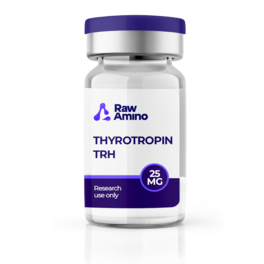
What Is Protirelin?
Protirelin is a synthetic tripeptide — formally structured as L-pyroglutamyl-L-histidyl-L-proline amide — that has been developed as an analog of thyrotropin-releasing hormone (TRH), a small peptide naturally produced in hypothalamic cells. As a TRH peptide, Protirelin is thought to mimic the functions of its endogenous counterpart, potentially engaging with TRH receptors — specifically TRH-1 and TRH-2 — on anterior pituitary gland cells in laboratory models.
When Protirelin binds to these G protein-coupled receptors, researchers propose that a cascade of intracellular events may be initiated — potentially contributing to the release of thyroid-stimulating hormone (TSH). Once released, TSH is believed to act on thyroid gland cells to stimulate the synthesis and secretion of thyroid hormones, including triiodothyronine (T3) and thyroxine (T4). Beyond this thyroid-related pathway, however, Protirelin has drawn considerable research interest for its potential influence on a much broader range of physiological processes — from brain signaling and neurotransmitter modulation to synaptic plasticity and autonomic regulation — making it a multifaceted subject of neuromodulator peptide and brain peptide research.
Protirelin and Hypothalamic Hormone Signaling
As a TRH peptide analog, one of Protirelin’s primary proposed research applications involves its use as an investigative tool for studying the cellular pathways that govern TRH synthesis and activity in hypothalamic cells. Research by Fliers et al. suggested that when applied in controlled studies using laboratory models, Protirelin may help researchers monitor downstream impacts on gene expression and transcription factor activation — mimicking aspects of endogenous TRH activity in a controllable research setting.
In particular, Protirelin may help illuminate how thyroid hormone feedback — potentially mediated by T3 — intersects with the cellular mechanisms that regulate TRH mRNA levels in hypothalamic neurons. Researchers have also proposed that since cytokines such as interleukin-1 may modulate TRH expression, Protirelin could serve as a useful tool for exploring whether immune mediators converge on shared intracellular pathways within TRH-producing neurons in laboratory settings. This positions Protirelin as a valuable research instrument not just for thyroid biology, but for the broader study of neuroendocrine signaling at the hypothalamic level.
Brain Signaling: A Broad Neuromodulator Peptide Profile
Perhaps the most expansive dimension of Protirelin’s brain peptide research profile is its potential to modulate central nervous system function independently of its role in pituitary or thyroid stimulation. Research by Marangell et al. noted that high-affinity receptors for Protirelin appear to be distributed throughout the brain — with particularly high density observed in regions such as the amygdala and hippocampus in laboratory models. This distribution has led researchers to propose a possible role for this TRH peptide in modulating CNS activity, including arousal, motor activity, and multiple neurotransmitter systems including serotonin and dopamine.
In laboratory models, Protirelin has been observed to influence both hyperactive and hypoactive states — potentially indicating a state-dependent mechanism of action that researchers have described as bidirectional modulation. This capacity to moderate CNS activity in opposite directions depending on the baseline state of the model has made Protirelin a particularly interesting neuromodulator peptide in brain peptide research circles. Research by Bunevicius et al. further noted that hypothalamic cell exposure to Protirelin may induce arousal from hibernation in certain research models — an observation that has added another dimension to its proposed CNS-modulating properties.
One proposed mechanism behind these CNS interactions involves Protirelin’s potential to reduce the release of excitatory amino acids in hippocampal brain cells. Research by Nie et al. observed that when cells were exposed to Protirelin and then subjected to high potassium stimulation — a standard laboratory method for provoking excitatory neurotransmitter release — the exposed cells showed a marked reduction in peak glutamate and aspartate release compared to controls. This inhibitory potential appeared consistent across all evaluated concentrations of the peptide and persisted beyond the end of stimulation. Notably, Protirelin did not appear to alter basal levels of these neurotransmitters in the absence of a depolarizing stimulus — suggesting a selective action that becomes most apparent under conditions of excitatory challenge in laboratory settings.
Researchers including Callahan et al. have also noted that Protirelin may modulate neurotransmitter systems involving serotonin, dopamine, acetylcholine, and norepinephrine — interactions thought to contribute to its broader neuromodulatory profile in brain peptide research. The researchers also noted that repeated exposure to Protirelin in the same cell cultures may induce tolerance — an important variable in the design of laboratory experiments involving this TRH peptide.
Autonomic Signaling in Laboratory Models
Alongside its central nervous system interactions, Protirelin has also been studied for its potential influence on autonomic signaling in laboratory settings. Research by Diz et al. explored the peptide’s effects within specific preoptic and hypothalamic nuclei, finding that Protirelin may influence sympathetic and parasympathetic signaling in a region-specific manner.
In experimental models, Protirelin exposure was associated with observable changes in cardiovascular parameters — including an approximate 7% increase in blood pressure and a 19% increase in heart rate — with heart rate responses appearing more pronounced across experimental models. Researchers proposed that these effects may involve partial inhibition of parasympathetic nerves that regulate the cardiovascular system, alongside potential adrenal catecholamine involvement. The researchers noted that both inhibition of the parasympathetic and activation of the sympathetic nervous systems may contribute to the observed responses — though adrenal involvement has not yet been confirmed in laboratory settings. These findings have added an autonomic dimension to Protirelin’s already broad neuromodulator peptide research profile, while also underscoring the importance of careful experimental design in this area of brain peptide research.
Protirelin and Synaptic Plasticity
One of the more nuanced areas of Protirelin’s research profile involves its potential interactions with synaptic plasticity — the cellular process by which the strength of neural connections changes over time in response to activity. Research by Watanave et al. explored Protirelin’s potential in TRH-deficient laboratory models, where the absence of TRH appeared to impede normal inhibitory neurotransmitter signaling.
In these models, Protirelin exposure appeared to restore normal signaling — and this restorative effect appeared to depend on the nitric oxide (NO)–cGMP pathway. When NO synthesis was inhibited in the laboratory models, Protirelin’s restorative potential was lost — while direct exposure to a membrane-permeable cGMP analog appeared to reinstate normal signaling. These findings have positioned this TRH peptide as a potentially useful tool for investigating the molecular mechanisms underlying synaptic plasticity in controlled laboratory environments.
Protirelin and Cholinergic Transmission
Rounding out Protirelin’s broad brain peptide research profile, research by Mellow et al. explored its potential interactions with cholinergic transmission in laboratory models — finding a modestly better supported semantic memory response following Protirelin exposure. Researchers noted that this effect appeared selective, with minimal impact observed on other cognitive domains such as attention, episodic memory, and visual memory in the models studied.
The precise mechanism behind this selective memory-related observation remains uncertain — with researchers proposing it may reflect a direct influence on cognitive circuits, or alternatively may be secondary to the broader arousal-supporting effects that Protirelin appears to produce in laboratory settings. Either way, this finding has added yet another dimension to the already expansive neuromodulator peptide research profile of this TRH peptide — and continues to prompt further investigation into the full scope of Protirelin’s interactions with CNS signaling pathways in controlled laboratory environments.
References
- Boler J, et al. The identity of chemical and hormonal properties of the thyrotropin-releasing hormone. Biochem Biophys Res Commun. 1969;37(4):705–10.
- Fliers E, et al. Decreased hypothalamic thyrotropin-releasing hormone gene expression in patients with nonthyroidal illness. J Clin Endocrinol Metab. 1997;82(12):4032–6.
- Marangell LB, et al. Effects of intrathecal thyrotropin-releasing hormone (protirelin) in refractory depressed patients. Arch Gen Psychiatry. 1997;54(3):214–22.
- Bunevicius R, Matulevicius V. Short-lasting behavioral effects of thyrotropin-releasing hormone in depressed women. Psychoneuroendocrinology. 1993;18(5-6):445–9.
- Nie Y, et al. Thyrotropin-releasing hormone (protirelin) inhibits potassium-stimulated glutamate and aspartate release from hippocampal slices in vitro. Brain Res. 2005;1054(1):45–54.
- Callahan AM, et al. Comparative antidepressant effects of intravenous and intrathecal thyrotropin-releasing hormone. Biol Psychiatry. 1997;41(3):264–72.
- Diz DI, Jacobowitz DM. Cardiovascular effects produced by injections of thyrotropin-releasing hormones into specific preoptic and hypothalamic nuclei in rats. Peptides. 1984;5(4):801–8.
- Watanave M, et al. Contribution of Thyrotropin-Releasing Hormone to Cerebellar Long-Term Depression and Motor Learning. Front Cell Neurosci. 2018;12:490.
- Mellow AM, et al. Acute effects of high-dose thyrotropin-releasing hormone infusions in Alzheimer’s disease. Psychopharmacology. 1989;98(3):403–7.
Disclaimer: The information provided is intended solely for educational and scientific discussion. The compounds described are strictly intended for laboratory research and in-vitro studies only. They are not approved for human or animal consumption, medical use, or diagnostic purposes. Handling is prohibited unless performed by licensed researchers and qualified professionals in controlled laboratory environments.