Introduction
Age-associated remodeling of the hypothalamic–pituitary–somatotropic (HPS) axis is characterized in laboratory models by attenuated growth hormone (GH) pulsatility, altered feedback sensitivity, and downstream shifts in energy allocation, tissue turnover, and sleep–wake regulation. This progressive change—often discussed under the umbrella of “somatopause” in preclinical literature—has been linked to modifications in body composition, extracellular-matrix dynamics, and electrophysiological sleep architecture across experimental preparations. Conventional strategies that elevate GH directly can obscure endogenous timing signals and feedback loops, complicating efforts to parse mechanism from effect in vivo and in vitro.
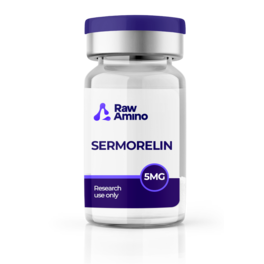
Peptide secretagogues that act upstream of GH synthesis and release provide a tractable framework for dissecting axis physiology. Sermorelin, a 29–amino acid analogue corresponding to the N-terminal region of growth hormone–releasing hormone (GHRH1–29), engages the pituitary GHRH receptor (GHRHR) and preserves native control circuitry. Because it is evaluated within intact feedback networks in animal and cellular systems, sermorelin offers a probe for studying how receptor occupancy translates into pulsatile GH dynamics, metabolic signaling, wound-healing programs, and sleep-relevant neuromodulation—without invoking direct, nonphysiologic GH exposure.
Receptor-Level Signaling at Somatotrophs
Sermorelin peptide binds GHRHR on anterior pituitary somatotrophs, coupling to Gs/adenylyl cyclase and elevating cAMP to activate protein kinase A, CREB phosphorylation, and GH gene transcription. Parallel Gq inputs can mobilize intracellular Ca²⁺, facilitating secretory vesicle fusion. In preclinical preparations, this dual-pathway engagement appears to amplify stimulus–secretion coupling while maintaining receptor desensitization kinetics that are compatible with recurrent, time-locked pulses. Importantly, the peptide acts within a milieu shaped by somatostatinergic inhibition and ghrelinergic co-stimulation, enabling interrogation of how excitatory and inhibitory currents summate to generate the characteristic ultradian rhythm of GH release.
Pulsatility and Feedback Dynamics
Unlike direct GH exposure—which produces monotonic concentration peaks—GHRHR agonism with sermorelin tends to preserve episodic output in experimental systems. Negative feedback via hepatic and local insulin-like growth factor-1 (IGF-1), as well as short-loop GH feedback at the hypothalamus, remain operational, limiting trough suppression and preventing the “overshoot–undershoot” patterns often observed with exogenous GH. Spectral and deconvolution analyses in animal studies suggest increased pulse mass with conserved inter-pulse intervals, indicating that sermorelin augments amplitude rather than abolishing temporal structure—a key distinction for downstream gene programs that are pulse-frequency sensitive.
Comparative Considerations with Exogenous GH
Head-to-head comparisons in preclinical contexts highlight a mechanistic contrast: direct GH exposure bypasses hypothalamic integration and can flatten pulsatility, whereas sermorelin leverages the intact HPS axis to scale endogenous output. This difference matters for tissues where signal decoding depends on duty cycle (e.g., adipocytes, skeletal muscle, and hepatocytes that distinguish between phasic and tonic GH to bias lipolysis, protein synthesis, or gluconeogenic programs). Consequently, sermorelin is frequently used as a tool to parse pulse-dependent transcriptional responses without confounding receptor saturation effects typical of nonphysiologic GH plateaus.
Anabolic and Lipolytic Pathway Engagement
By elevating physiologic GH pulses, sermorelin indirectly modulates JAK2–STAT5, MAPK, and PI3K–AKT cascades in target tissues. In muscle, pulse-synchronized STAT5 signaling has been associated in animal models with ribosomal biogenesis and myofibrillar turnover, whereas in adipose depots, GH-linked hormone-sensitive lipase activation favors mobilization of stored lipids. These axis-level shifts contribute to experimentally observed changes in body composition proxies—enhanced lean indices and reduced adiposity—without invoking direct receptor action in peripheral tissues by the peptide itself. Such readouts emphasize that sermorelin functions as an upstream rheostat, not as a peripherally acting effector.
Matrix Remodeling and Injury Biology
Injury models indicate that GHRH-pathway activation can adjust cytokine tone and matrix deposition kinetics. Sermorelin—by augmenting GH pulses and downstream IGF-related signaling—has been reported to skew fibroblast activity, collagen crosslinking, and angiogenic responses in vivo, aligning with reduced pro-inflammatory cytokines and altered scar architecture in experimental settings. Cardiac ischemia models further suggest engagement of pro-survival kinase networks (e.g., ERK1/2 and PI3K-AKT) and microvascular remodeling, consistent with a general theme: upstream modulation of the somatotropic axis influences damage-response programs that integrate inflammation, perfusion, and extracellular-matrix organization.
Neuropeptidergic Links to Sleep Architecture
GH secretory bursts are temporally coupled to slow-wave sleep in many species, and GHRHergic signaling intersects with hypothalamic arousal circuits. In fish and mammalian preparations, GHRH-axis stimulation has been associated with adjustments in orexin/hypocretin dynamics and deep-sleep consolidation. Within this framework, sermorelin serves as a probe for testing how enhancing endogenous GHRH receptor activity alters stage distribution (e.g., slow-wave enrichment), sleep latency, and oscillatory patterns tied to glymphatic flux and synaptic homeostasis—mechanistic domains increasingly interrogated in preclinical neurobiology.
Aging, Somatopause, and Longevity Signals
The relationship between GH, healthspan, and lifespan is nuanced across model organisms. Lifelong reductions in GH/IGF-1 signaling can extend lifespan in some strains, yet late-life maintenance of youthful pulsatility has been linked to improved physiological function in others. Sermorelin allows investigators to isolate the contribution of pulse amplitude and timing—rather than constitutive GH exposure—when testing aging hypotheses. By titrating endogenous rhythms in older experimental subjects, researchers can examine whether restoring specific temporal features of GH output modulates metabolic flexibility, proteostasis, and resilience to stressors without obscuring feedback control.
Conclusion
Across experimental systems, sermorelin operates as an upstream modulator of the HPS axis, augmenting GH pulse amplitude while preserving native feedback and timing. This positioning enables mechanistic dissection of how phasic GH signaling influences tissue anabolism, lipid mobilization, matrix remodeling, and sleep-linked neurobiology. Current evidence supports its value as a research tool for probing somatotropic network behavior under aging and injury paradigms. Further laboratory investigations—integrating endocrine profiling with multi-omic and behavioral readouts—are warranted to delineate causality, dose–response relationships in controlled settings, and context-specific downstream effects.
References
- R. M. Kanashiro-Takeuchi et al., “New therapeutic approach to heart failure due to myocardial infarction based on targeting growth hormone-releasing hormone receptor,” Oncotarget, vol. 6, no. 12, 2015, doi: 10.18632/oncotarget.3303.
- L. Recinella et al., “Antinflammatory, antioxidant, and behavioral effects induced by administration of growth hormone-releasing hormone analogs in mice,” Sci. Rep., vol. 10, no. 1, Jan. 2020, doi: 10.1038/s41598-019-57292-z.
- A. Bartke, E. Hascup, K. Hascup, and M. M. Masternak, “Growth Hormone and Aging: New Findings,” World J. Mens Health, vol. 39, no. 3, pp. 454–465, Jul. 2021, https://doi.org/10.5534/wjmh.200201
- Bagno Luiza L. et al., “Growth Hormone–Releasing Hormone Agonists Reduce Myocardial Infarct Scar in Swine With Subacute Ischemic Cardiomyopathy,” J. Am. Heart Assoc., vol. 4, no. 4, Jan. 2021, doi: 10.1161/JAHA.114.001464.
- R. F. Walker, “Sermorelin: a better approach to management of adult-onset growth hormone insufficiency?,” Clin. Interv. Aging, vol. 1, no. 4, 2006, doi: 10.2147/ciia.2006.1.4.307.
- B. S. Shepherd et al., “Endocrine and orexigenic actions of growth hormone secretagogues in rainbow trout (Oncorhynchus mykiss),” Comp. Biochem. Physiol. A. Mol. Integr. Physiol., vol. 146, no. 3, Mar. 2007, doi: 10.1016/j.cbpa.2006.11.004.
Disclaimer: The information provided is intended solely for educational and scientific discussion. The compounds described are strictly intended for laboratory research and in-vitro studies only. They are not approved for human or animal consumption, medical use, or diagnostic purposes. Handling is prohibited unless performed by licensed researchers and qualified professionals in controlled laboratory environments.