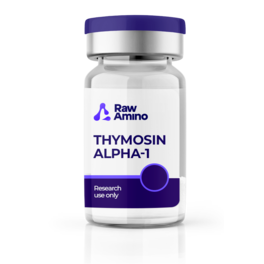
What Is Thymosin Alpha-1?
Thymosin Alpha-1 peptide, commonly abbreviated as Tα1, is one of the more extensively studied compounds in thymus peptide research. First identified in 1972 within extracts from the thymus gland, an organ considered essential for immune system development, Tα1 originates from a larger precursor molecule called Prothymosin Alpha, which consists of 113 amino acids and is naturally present in thymus cells.
What sets Thymosin Alpha-1 apart from many other immune research subjects is the breadth of its proposed interactions across both innate and adaptive immune responses in laboratory models. Rather than acting on a single receptor or pathway, this immune cell maturation peptide appears to engage multiple molecular pathways simultaneously, potentially influencing everything from T-cell differentiation and cytokine regulation to antioxidant enzyme activity and nerve cell development in controlled laboratory environments.
Thymosin Alpha-1 and Immune Cell Maturation
At the foundation of Thymosin Alpha-1 peptide research is its proposed ability to influence the differentiation and maturation of key immune cell populations in laboratory models. Research by Dominari et al. proposed that Tα1 may influence the maturation of CD4+ helper T cells and CD8+ cytotoxic T cells through its interactions with toll-like receptors (TLRs) on antigen-presenting cells. The researchers noted that Thymosin Alpha-1 functions as a TLR-9 and TLR-2 agonist in both myeloid and dendritic cells, potentially stimulating cytokine production and enhancing antigen-presenting capabilities in laboratory settings.
By interacting with TLRs on dendritic cells, Thymosin Alpha-1 peptide is thought to enhance their phagocytic ability and capacity for antigen presentation in laboratory models. Research using murine models suggested Tα1 may modulate the activity of natural killer cells and CD8+ T cells, both considered important for identifying and responding to infected or abnormal cells in laboratory settings.
Research by Tao et al. further explored the molecular mechanisms involved, suggesting that Tα1 may bind to TLR3, TLR4, and TLR9, activating intracellular signaling pathways including IRF3 and NF-κB. These pathways are proposed to drive the proliferation and activation of immune cells in laboratory models. Additional TLRs including TLR2 and TLR7 may also play a role, triggering pathways such as TLR2/NF-κB, TLR2/p38 MAPK, and TLR7/MyD88, all considered integral to cytokine production and immune cell maturation in these experimental settings.
Thymosin Alpha-1 and Immune Cell Differentiation
Building on its maturation interactions, Thymosin Alpha-1 has also been studied for its potential role in guiding immune cell differentiation toward specific functional subtypes in laboratory models. Research by Tao et al. suggested that Tα1 may promote the differentiation of precursor T cells into cytotoxic T lymphocytes, potentially supporting the immune system’s ability to respond to infected cellular targets in laboratory settings.
Tα1 also appeared to be involved in the differentiation of dendritic cells in laboratory models, potentially increasing the expression of surface activation markers considered critical for T-cell stimulation. Researchers further proposed that Thymosin Alpha-1 peptide may influence the polarization of T-helper cell subsets depending on the cytokine environment present in laboratory conditions, adding a context-dependent dimension to this thymus peptide research subject’s differentiation profile.
Thymosin Alpha-1 and Immune Cell Response Regulation
One of the most nuanced aspects of Thymosin Alpha-1 peptide’s immune research profile involves its proposed dual role in both stimulating and moderating immune responses depending on the laboratory context studied.
Research by Dominari et al. suggested that Tα1 may induce the production of key immune mediators including interleukins IL-2, IL-10, and IL-12, alongside interferons IFN-α and IFN-γ in laboratory models. The peptide’s potential to stimulate these cytokines has led researchers to hypothesize it might be of value in studying immunodeficient laboratory models, as well as in investigating excessive immune responses such as cytokine storm models.
On the other hand, the same researchers highlighted that some murine model studies suggest Tα1 may reduce levels of IL-1β and TNF-α, two key inflammatory cytokines, potentially offering a moderating influence in conditions characterized by excessive inflammation in laboratory settings. Research by Matteucci et al. observed that Tα1 may help moderate cytokine dysregulation in laboratory models exposed to proinflammatory stimuli, with CD8+ T cells appearing to reduce production of certain cytokines associated with IL-17 and TLR signaling pathways.
Tα1 also appeared to influence the expression of activation markers such as CD38 and HLA-DR in CD8+ T cells in murine inflammation models, with the peptide reducing the expression of these markers and suggesting a possible role in moderating overly active immune responses. Researchers noted these actions appear context-dependent, with Tα1 regulating immune pathways differently depending on whether the laboratory environment is inflammatory or not. Tα1 has also been suggested to upregulate IL-10, an anti-inflammatory cytokine, potentially contributing to a dual role of suppressing proinflammatory cytokines while promoting cytokines that help restore immune balance in laboratory models.
Thymosin Alpha-1 and Tumor Cell Research
Thymosin Alpha-1 has also been explored for its potential interactions with tumor cells in laboratory models, with researchers proposing that these observations may be linked to Tα1’s immunomodulatory properties.
Research by Kharazmi-Khorassani et al. suggested that Tα1 may inhibit tumor cell migration in laboratory settings. Studies using scratch assays indicated that Tα1 potentially reduced the migratory capacity of A549 cells by approximately 20 to 26.5% after 48 hours in these models, though the underlying mechanisms were noted as speculative by the researchers. Thymosin Alpha-1 peptide may also influence the tumor microenvironment in laboratory models by modulating immune infiltration and enhancing antigen presentation, with studies suggesting Tα1 may induce the expression of MHC class I on tumor cells, potentially increasing their visibility to T cells in laboratory settings.
Research by Costantini et al. further proposed that Tα1 may contribute to sustaining immune surveillance in laboratory models, potentially helping to moderate the balance between effector T cells and regulatory T cells. As with all sections of this article, these findings are presented as preliminary laboratory observations requiring further controlled investigation before broader conclusions can be drawn.
Thymosin Alpha-1 and Antioxidant Properties
Beyond its immune research profile, Thymosin Alpha-1 peptide has also drawn research interest for its potential antioxidant properties in laboratory models. Research by Dominari et al. suggested that Tα1 may reduce oxidative stress by enhancing antioxidant enzyme activities including superoxide dismutase and glutathione peroxidase in various cell types studied in animal models.
Research by Kharazmi-Khorassani et al. further suggested that Tα1 may modulate the activity of critical antioxidant enzymes in A549 cells, with apparent enhancements of catalase, superoxide dismutase, and glutathione peroxidase activity observed in a concentration-dependent manner in laboratory settings. This enhancement of antioxidant enzyme activity may contribute to Tα1’s proposed ability to reduce reactive oxygen species levels in these laboratory models, adding an antioxidant dimension to this immune cell maturation peptide’s broad research profile.
Thymosin Alpha-1 and Nerve Cell Interactions
Rounding out this thymus peptide research subject’s expansive research profile, Thymosin Alpha-1 has also been studied for its potential interactions with nerve cell development in laboratory models. Research by Wang et al. indicated that Tα1 may have immunomodulatory actions that influence neurodevelopment in murine models, with researchers reporting increased expression of neural progenitor markers such as nestin and Tbr2, as well as newly formed nerve cells identified by BrdU and NeuN-positive markers. These observations were especially notable in the hippocampus in laboratory settings.
Researchers proposed that Tα1 may promote a Th1 cell response bias, characterized by increased levels of IFN-γ and IL-4, both associated with neurogenesis in laboratory models. Tα1 also appeared to reduce levels of pro-inflammatory cytokines including IL-6 and TNF-α in these models, potentially supporting a more neurotrophic environment for nerve cell function. Additionally, Tα1 appeared to increase the expression of BDNF, NGF, and IGF-1 in the hippocampus in laboratory models, with researchers proposing that the interplay between immune modulation and neurotrophic signaling triggered by Thymosin Alpha-1 peptide may create an environment that supports nerve cell development and function in controlled laboratory environments.
References
- Pierluigi B, et al. Thymosin alpha1: the regulator of regulators? Ann N Y Acad Sci. 2010;1194:1–5.
- Li J, Liu CH, Wang FS. Thymosin alpha 1: biological activities, applications and genetic engineering production. Peptides. 2010;31(11):2151–2158.
- Dominari A, et al. Thymosin alpha 1: A comprehensive review of the literature. World J Virol. 2020;9(5):67–78.
- Tao N, et al. Thymosin α1 and Its Role in Viral Infectious Diseases. Molecules. 2023;28(8):3539.
- Matteucci C, et al. Thymosin Alpha 1 Mitigates Cytokine Storm in Blood Cells From Coronavirus Disease 2019 Patients. Open Forum Infect Dis. 2020;8(1):ofaa588.
- Kharazmi-Khorassani J, Asoodeh A. Thymosin alpha-1; a natural peptide inhibits cellular proliferation and cell migration in A549 cells. Environ Toxicol. 2019;34(8):941–949.
- Costantini C, et al. A Reappraisal of Thymosin Alpha1 in Cancer Therapy. Front Oncol. 2019;9:873.
- Wang G, et al. Immunopotentiator Thymosin Alpha-1 Promotes Neurogenesis and Cognition in the Developing Mouse via a Systemic Th1 Bias. Neurosci Bull. 2017;33(6):675–684.
Disclaimer: The information provided is intended solely for educational and scientific discussion. The compounds described are strictly intended for laboratory research and in-vitro studies only. They are not approved for human or animal consumption, medical use, or diagnostic purposes. Handling is prohibited unless performed by licensed researchers and qualified professionals in controlled laboratory environments.