What Is IGF-1 LR3?
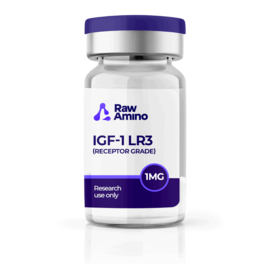
IGF-1 LR3 peptide — formally known as Receptor Grade IGF-1 Long R3 — is one of the more actively studied compounds in IGF-1 peptide research circles. It is a modified version of insulin-like growth factor 1 (IGF-1), the body’s natural mediator of growth hormone’s anabolic potential. To create IGF-1 LR3, scientists made two key structural changes to the original IGF-1 molecule: replacing the third amino acid with arginine, and adding an extra sequence of 13 amino acids to the N-terminus.
These modifications are not arbitrary. Researchers believe they may support the peptide’s biological activity by potentially increasing its affinity for IGF receptors while reducing its tendency to bind to proteins that would otherwise deactivate it. The result is a compound that appears more stable and potentially more potent than the original IGF-1 molecule in laboratory settings — making it a compelling subject across multiple areas of anabolic growth factor and muscle growth factor research.
The term “”Receptor Grade”” in its name refers to the higher purity of this specific research reagent compared to alternatives such as Media Grade IGF-1 LR3. In laboratory research involving cellular growth, IGF receptors, and IGF-binding proteins, even small differences in purity can meaningfully impact experimental outcomes — making this distinction an important one for researchers working in this space.
IGF-1 LR3 Peptide and IGF Receptors: Why the Modifications Matter
To understand what makes IGF-1 LR3 a distinctive IGF-1 peptide in laboratory settings, it helps to understand how the original IGF-1 molecule behaves — and where the modified version diverges. Under normal circumstances, IGF-1 binds readily to a group of proteins called IGF-binding proteins (IGFBPs), forming a large molecular complex that influences how the peptide is retained and distributed in research models.
Research by Bastian et al. suggested that due to its modified structure, IGF-1 LR3 may not bind to these IGF-binding proteins at all — instead remaining predominantly as a free peptide in laboratory models. This distinction has notable implications. While IGF-1 bound to IGFBPs may be retained in research models for longer periods, IGF-1 LR3’s lack of this association appears to result in faster clearance — with researchers noting that the metabolic clearance rate for IGF-1 LR3 was approximately 11-fold higher than for IGF-1 in the models studied.
At first glance, faster clearance might seem like a disadvantage — but researchers have proposed a more nuanced picture. Research by Elis et al. suggested that modifications reducing a peptide’s affinity for IGF-binding proteins may support an increase in the amount of free, bioactive IGF-1 available at tissue sites. As a free peptide, IGF-1 LR3 may more readily interact with IGF-1 receptors directly — potentially supporting a more robust anabolic growth factor response at the cellular level in laboratory settings.
IGF-1 LR3 Peptide and Cellular Yield: A Research Tool With Broad Applications
One of the more practically significant areas of IGF-1 LR3 research involves its potential as a tool for supporting cell viability and protein production in laboratory cell culture settings. Research by Morris et al. explored how IGF-1 LR3 compared to other common cell stimulants — particularly insulin — in serum-free cell cultures.
The findings were notable. Cultures exposed to IGF-1 LR3 at concentrations above 0.05 μg/mL appeared to maintain approximately 75–80% cell viability after 10 days — while cultures exposed to insulin displayed lower viability that in some cases dropped below 50% under the same conditions. Researchers proposed that this better-supported viability may be related to IGF-1 LR3’s more immediate activation of IGF-1 receptors, which appear to be more abundant in these cell types than insulin receptors.
The study further suggested that IGF-1 LR3 may induce different receptor conformational changes and cycling dynamics — potentially contributing to more prolonged signaling and sustained protein production in laboratory cultures. These findings have positioned this IGF-1 peptide as a valuable research tool beyond muscle biology alone — with applications across cell culture systems more broadly.
IGF-1 LR3 Peptide and Cellular Hypertrophy: An Anabolic Growth Factor in Laboratory Models
Among the most actively studied dimensions of IGF-1 LR3’s research profile is its potential as an anabolic growth factor in laboratory models — particularly its apparent ability to support protein synthesis while moderating protein breakdown in cellular environments.
Research by Thomas et al. in catabolic research models suggested that IGF-1 LR3 may be more anabolic than the original IGF-1 — an observation researchers attributed largely to its reduced binding to IGF-binding proteins. By remaining as a free peptide, IGF-1 LR3 may be transferred more rapidly to tissue sites, potentially resulting in higher local concentrations that could support protein synthesis while decreasing protein breakdown. Researchers measured this through markers including nitrogen retention and 3-methylhistidine excretion — a marker associated with muscular tissue protein breakdown — and concluded that IGF-1 LR3 may have been approximately 2.5-fold more potent than IGF-1 at supporting weight gain and nitrogen retention in the research models studied.
These findings have made IGF-1 LR3 a closely watched compound in anabolic growth factor research — and a useful reference point for researchers studying the relationship between IGF receptor activation and cellular protein dynamics in laboratory settings.
IGF-1 LR3 and Muscle Cell Research: A Muscle Recovery Peptide Perspective
Two additional areas of muscle-focused laboratory research have further broadened the IGF-1 LR3 research profile — exploring its potential interactions with muscle cell damage and protein conservation in laboratory models.
Research by Gehrig et al. examined IGF-1 LR3’s potential in dystrophic skeletal muscle cell models subjected to contraction-mediated injury — a common laboratory model for studying muscle cell susceptibility to mechanical stress. Muscle cells exposed to IGF-1 LR3 appeared to exhibit a lower force deficit following lengthening contractions compared to control cells across multiple muscle types studied, including the extensor digitorum longus, soleus, and diaphragm. Researchers proposed that bypassing the inhibitory effects of IGF-binding proteins with IGF-1 LR3 may allow for better-supported activation of IGF signaling pathways that contribute to reduced contraction-induced damage — though the exact mechanisms remain an area of ongoing investigation.
Complementing these findings, research by Hill et al. explored IGF-1 LR3’s potential interactions with muscle protein conservation in laboratory models. Plasma levels of 3-methylhistidine — a marker associated with muscular tissue protein breakdown — appeared approximately 20% lower in peptide-exposed research models compared to controls. Researchers suggested that IGF-1 LR3 may exert an anti-catabolic influence on muscle cells by moderating the balance between protein synthesis and breakdown in a manner that favors muscular tissue mass conservation in laboratory settings — a finding that continues to make this compound a meaningful subject in muscle recovery peptide research.
References
- Thomas JN, Fung V. Comparison of long R3 IGF-1 with insulin in the support of cell growth and recombinant protein expression in CHO cells. Animal Cell Technology. 1994:91–95.
- Bastian SE, et al. Plasma clearance and tissue distribution of labelled IGF-1 and an analogue LR3IGF-I in pregnant rats. J Endocrinol. 1993;138(2):327–36.
- Mongongu C, et al. Detection of LongR3-IGF-I, Des(1-3)-IGF-I, and R3-IGF-I using immunopurification and high resolution mass spectrometry. Drug Test Anal. 2021;13(7):1256–1269.
- Elis S, et al. Unbound (bioavailable) IGF1 enhances somatic growth. Dis Model Mech. 2011;4(5):649–58.
- Morris AE, Schmid J. Effects of insulin and LongR3 on serum-free Chinese hamster ovary cell cultures. Biotechnol Prog. 2000;16(5):693–7.
- Tomas FM, et al. IGF-1 and especially IGF-1 variants are anabolic in dexamethasone-treated rats. Biochem J. 1992;282(Pt 1):91–7.
- Gehrig SM, et al. Insulin-like growth factor-I analogue protects muscles of dystrophic mdx mice from contraction-mediated damage. Exp Physiol. 2008;93(11):1190–8.
- Hill RA, et al. Action of long(R3)-insulin-like growth factor-1 on protein metabolism in beef heifers. Domest Anim Endocrinol. 1999;16(4):219–29.
Disclaimer: The information provided is intended solely for educational and scientific discussion. The compounds described are strictly intended for laboratory research and in-vitro studies only. They are not approved for human or animal consumption, medical use, or diagnostic purposes. Handling is prohibited unless performed by licensed researchers and qualified professionals in controlled laboratory environments.