What Is the Frag 176-191 / CJC-1295 / Ipamorelin Peptide Blend?
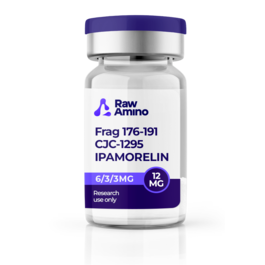
For those curious about the cutting edge of growth hormone peptide research, this three-peptide blend offers a fascinating case study. Each of the three compounds in this combination — Frag 176-191 / CJC-1295 / Ipamorelin — is believed to interact with hormonal and metabolic systems through distinct mechanisms, making their combined study a particularly active area of laboratory investigation.
Before exploring how they may work together, it helps to understand what each peptide is and what researchers currently know about it individually.
Fragment 176-191: A Lipolysis Peptide Derived From Growth Hormone
Fragment 176-191, sometimes referred to as Frag 176-191, is a synthetic peptide derived from a specific segment of the growth hormone (hGH) molecule — specifically residues 176 through 191 at its C-terminal end. To improve stability, the first amino acid in this segment has typically been replaced with a tyrosine residue at the N-terminal end.
One of the more structurally notable features of this lipolysis peptide is its conserved disulfide bond — a chemical bridge between two cysteine residues that researchers believe may support the peptide’s stability and resistance to enzymatic breakdown in laboratory settings.
What makes Fragment 176-191 particularly interesting to researchers is what it appears to retain — and what it appears to leave behind — from the full hGH molecule. Studies suggest it may mimic growth hormone’s fat-breaking (lipolytic) potential in laboratory models, while appearing not to influence carbohydrate metabolism, IGF-1 synthesis, or cellular proliferation in the same way the full molecule does.
Research by Ng et al. observed that Fragment 176-191 may support lipolytic activity in laboratory models by approximately 23%, while also potentially reducing adipose tissue accumulation by over 50% in those same models. Research by Heffernan et al. further noted that fatty acid oxidation rates in obesity research models appeared to increase by as much as 216% following exposure to the peptide — findings that have made this a closely watched compound in metabolic research circles.
CJC-1295: A Growth Hormone Peptide That Targets the Pituitary
CJC-1295, also known as Modified GRF 1-29, is a synthetic analog derived from the first 29 amino acids of the body’s naturally occurring Growth Hormone Releasing Hormone (GHRH). As its name suggests, it is “”modified”” — differing from endogenous GHRH through specific amino acid substitutions at positions 2, 8, 15, and 27.
These modifications are not arbitrary. Researchers believe the substitutions at positions 2, 15, and 27 may help the peptide resist enzymatic breakdown and extend its half-life in laboratory settings, while the substitution at position 8 may improve how well it binds to its target receptor. The result is a growth hormone peptide that is thought to retain — and potentially surpass — the natural GHRH molecule’s ability to stimulate growth hormone secretion from pituitary cells.
In laboratory settings, CJC-1295 is believed to interact with GHRH receptors on anterior pituitary cells, potentially triggering a signaling cascade that ultimately supports the synthesis and release of growth hormone. Research by Alba et al. further suggested that the peptide may increase total RNA levels within pituitary tissue and elevate the messenger RNA responsible for encoding growth hormone — possibly reflecting an increase in the population of growth hormone-producing cells.
Ipamorelin: A Selective Growth Hormone Secretagogue
Ipamorelin, also identified by its experimental label NNC 26-0161, is a pentapeptide — a chain of just five amino acids — with the sequence Aib-His-D-2-Nal-D-Phe-Lys-NH₂. Unlike CJC-1295, which targets GHRH receptors, Ipamorelin belongs to a class of compounds known as Growth Hormone Secretagogues (GHS) and is believed to act on a different receptor entirely — the GHS receptor 1a, also known as the ghrelin receptor.
What sets Ipamorelin apart from other growth hormone secretagogues in research settings is its selectivity. While other compounds in its class may also influence the secretion of cortisol or prolactin, Ipamorelin appears to selectively stimulate growth hormone synthesis — making it a cleaner research tool for isolating growth hormone-related effects in laboratory models.
Research by Jiménez-Reina et al. suggests that Ipamorelin’s binding to ghrelin receptors may initiate a complex intracellular signaling pathway involving phospholipase C, ultimately supporting growth hormone synthesis and secretion in pituitary cells.
Research by Lall et al. also suggests that Ipamorelin may interact with ghrelin receptors located within the nervous system in laboratory models, potentially promoting signals associated with hunger hormone activity — an observation that adds an additional layer of complexity to how this peptide may influence metabolic processes in research settings.
How the Frag 176-191 / CJC-1295 / Ipamorelin Blend Works Together
With each peptide understood individually, the research rationale behind combining them becomes clearer. Fragment 176-191 appears to interact directly with fat cells as a lipolysis peptide, while CJC-1295 and Ipamorelin are believed to work upstream — stimulating growth hormone secretion from pituitary cells, which may in turn influence fat cell metabolism indirectly.
What makes this combination particularly interesting to researchers is the possibility of a synergistic effect. A literature review by Sinha et al. highlighted preliminary findings in which GHRH analogs and GHS-R agonists applied separately appeared to elevate pulsatile growth hormone secretion by approximately 20-fold and 47-fold above baseline respectively. When the two were combined in laboratory environments, the reported increase rose to approximately 54-fold — a figure that has prompted considerable interest in studying these peptides as a blend rather than in isolation.
Research by Khorram et al. suggests CJC-1295 alone may support growth hormone secretion by approximately 70% to 107% compared to controls in laboratory settings, while Gobburu et al. reported that Ipamorelin may elevate growth hormone concentrations by approximately 60-fold relative to placebo-exposed samples under laboratory conditions.
Depot-Specific Fat Cell Interactions: What the Research Suggests
One of the more nuanced findings in this area of research involves how growth hormone — and by extension this growth hormone peptide blend — may interact differently with different types of fat tissue. Research by Dehkhoda et al. suggests that growth hormone may impact fat tissue in a location-specific manner, with visceral fat deposits potentially displaying a higher density of growth hormone receptors than subcutaneous fat deposits.
Researchers have proposed that Fragment 176-191 may follow a similar pattern of depot-specific interactions, though further investigation is needed to clarify this. Meanwhile, Ipamorelin’s potential influence on ghrelin signaling may add yet another layer to this picture, as subcutaneous fat deposits — which may be less responsive to growth hormone-mediated lipolysis — could be differentially affected by hunger hormone signaling in laboratory models.
References
- Isidro ML, Cordido F. Approved and Off-Label Uses of Obesity Medications. Pharmaceuticals. 2010;3(1):125–145.
- Cox HD, et al. Detection and in vitro metabolism of AOD9604. Drug Test Anal. 2015;7(1):31–8.
- Jetté L, et al. Human GRF1-29-albumin bioconjugates activate the GRF receptor. Endocrinology. 2005;146(7):3052–3058.
- Raun K, et al. Ipamorelin, the first selective growth hormone secretagogue. Eur J Endocrinol. 1998;139(5):552–61.
- Sinha DK, et al. Beyond the androgen receptor: the role of growth hormone secretagogues. Transl Androl Urol. 2020;9(S2):S149–S159.
- Alba M, et al. Once-daily administration of CJC-1295 normalizes growth in the GHRH knockout mouse. Am J Physiol Endocrinol Metab. 2006;291(6):E1290–4.
- Jiménez-Reina L, et al. Impact of chronic treatment with Ipamorelin in young female rats. Histol Histopathol. 2002;17(3):707–14.
- Ng FM, et al. Metabolic studies of a synthetic lipolytic domain (AOD9604). Horm Res. 2000;53(6):274–8.
- Ng FM, et al. Molecular and cellular actions of AOD9401 on lipid metabolism. J Mol Endocrinol. 2000;25(3):287–98.
- Heffernan MA, et al. Increase of fat oxidation and weight loss in obese mice. Int J Obes. 2001;25(10):1442–9.
- Dehkhoda F, et al. The Growth Hormone Receptor: Mechanism of Activation and Cell Signaling. Front Endocrinol. 2018;9:35.
- Lall S, et al. GH-independent stimulation of adiposity by GH secretagogues. Biochem Biophys Res Commun. 2001;280(1):132–8.
- Khorram O, et al. Endocrine and metabolic effects of long-term GHRH administration. J Clin Endocrinol Metab. 1997;82(5):1472–1479.
- Gobburu JV, et al. Pharmacokinetic-pharmacodynamic modeling of ipamorelin. Pharm Res. 1999;16(9):1412–6.
Disclaimer: The information provided is intended solely for educational and scientific discussion. The compounds described are strictly intended for laboratory research and in-vitro studies only. They are not approved for human or animal consumption, medical use, or diagnostic purposes. Handling is prohibited unless performed by licensed researchers and qualified professionals in controlled laboratory environments.