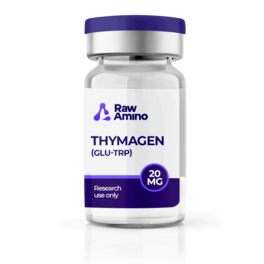

What Is Thymagen Peptide?
Thymagen peptide is one of the more intriguing compounds currently being explored in immune regulation peptide research circles. Also known as EW or Glutamyl-Tryptophan, it is a dipeptide composed of just two amino acids, glutamine and tryptophan, making it one of the smallest compounds in the Khavinson peptide bioregulator family. This classification is significant: Khavinson peptides are a group of short amino acid chains studied for their potential to regulate gene expression and modulate fundamental physiological mechanisms in laboratory settings.
Thymagen is a synthetic analog of thymalin, a thymus-derived polypeptide, and has been explored for its potential interactions with various immune cell types in laboratory models. Research by Khavinson et al. suggested that Thymagen may react specifically with the AACG sequence in DNA, a combination of four nucleotides, potentially influencing gene expression patterns relevant to immune cell function. This proposed DNA-binding capability has made this Khavinson peptide a particularly compelling subject for researchers studying the molecular basis of immune regulation.
Immune Cell Sensitization
One of the most actively studied areas of Thymagen peptide research involves its potential interactions with immune cell signaling pathways, particularly its proposed ability to modulate the balance between two important second messengers: cyclic adenosine monophosphate (cAMP) and cyclic guanosine monophosphate (cGMP).
Research by Demidov et al. suggested that these cyclic nucleotides serve as essential regulators of immune cell activity. The ratio of cAMP to cGMP within immune cells is considered particularly important because it helps determine the direction and magnitude of immune responses in laboratory models. During immune sensitization, where the immune system becomes hypersensitive to specific antigens, this ratio tends to decrease, potentially disrupting normal cellular signaling and contributing to exaggerated immune responses or chronic inflammation in laboratory settings.
Thymagen peptide appears to modulate this balance by influencing the activity of phosphodiesterases, the enzymes responsible for breaking down cyclic nucleotides. By potentially increasing the activity of these enzymes, Thymagen may promote the catabolism of excess cAMP and cGMP in laboratory models, helping to restore their balance within immune cells. Researchers proposed that by normalizing the cAMP/cGMP ratio, this immune regulation peptide may help maintain cellular homeostasis even under conditions that typically cause signaling imbalances, potentially moderating the overactivation or underactivation of immune responses in laboratory settings.
Thymagen Peptide and Immune Cell Responsiveness
Building on its proposed signaling modulation properties, Thymagen has also been studied for its potential interactions with immune cell responsiveness in laboratory infection models. Research by Iushchuk et al. explored Thymagen peptide’s potential in experimental models of Yersinia enterocolitica infections, identifying several proposed mechanisms of interest.
One key observation involved Thymagen’s potential to decrease polyclonal immune activation, a state in which multiple clones of immune cells become overactivated and may produce excessive or potentially harmful immune responses. By possibly moderating this overactivation, this Khavinson peptide may help reduce the development of autoimmune-like reactions in such laboratory infection models.
Beyond adaptive immune interactions, Thymagen also appeared to support nonspecific defense mechanisms in laboratory models, including the activity of macrophages and natural killer cells. Researchers proposed that strengthening these innate responses may reduce bacterial dissemination to other tissues in laboratory settings, potentially supporting the elimination of infectious agents by immune cells. These findings have contributed to growing interest in Thymagen as a research tool for studying innate and adaptive immune coordination in controlled laboratory environments.
Cardiac Cell Research
Beyond its immune regulation peptide profile, Thymagen has also been explored for its potential interactions with cardiac cells in laboratory settings. Research by Filippova et al. in cardiac cell models suggested that Thymagen peptide may have actions that moderate damage to these cells under ischemic conditions in laboratory settings.
The researchers noted that the precise mechanism underlying this observation remained unclear in their investigation, concluding that the peptide’s observed interactions in these models did not appear to involve opiate receptors or calcium channel blockade in cardiac cells. While this area of Thymagen research remains early stage and mechanistically uncertain, it has added a cardioprotective dimension to this Khavinson peptide’s broader laboratory research profile that researchers continue to investigate.
Thymagen Peptide and Tumor Cell Research
One of the more nuanced areas of Thymagen peptide research involves its potential interactions with tumor cell development in laboratory models. Research by Bespalov et al. observed that Thymagen appeared to decrease tumor incidence and reduce tumor multiplicity in laboratory models exposed to carcinogens, with researchers proposing that this potential may be linked to Thymagen’s immune-stimulating properties.
Specifically, Thymagen is believed to support T-cell function in laboratory models, which plays a role in identifying and responding to cells that have undergone abnormal transformation. Stimulated immune cells might secrete cytokines and other factors that inhibit tumor cell proliferation and promote programmed cell death in laboratory settings. Research by Anisimov et al. further reported that Thymagen peptide may lead to a reduction in the occurrence of radiation-induced tumor cells in laboratory models, with particularly notable observations in cell lines originating from breast tissue. Researchers also noted that laboratory models exposed to Thymagen without any radionuclide exposure appeared to exhibit a longer cellular lifespan and slower rate of cellular aging, alongside a lower overall occurrence of both malignant and benign tumor cells. These findings suggest that this immune regulation peptide may have broader interactions with cellular aging processes that extend beyond its primary immune research profile, though researchers emphasize that further controlled investigation is needed.
Immune Cell Deficiency Research
Rounding out this Khavinson peptide’s immune research profile, Thymagen has also been studied in laboratory models of immune cell deficiency. Research by Zhuk et al. suggested that Thymagen peptide may alleviate signs of secondary immunodeficiency by activating the maturation and function of T cells in laboratory models of autoimmunity. The researchers reported positive outcomes in 94.4% of models studied, with 83.3% indicating positive changes in laboratory markers of immune function.
Further research by Khmel’nitskiĭ et al. suggested that Thymagen may also moderate the severity of fungal infections such as candidiasis in laboratory models of immunosuppression. Researchers proposed that Thymagen may activate immune system components including the thymus gland in these models, potentially supporting a more robust defense response against fungal pathogens. These findings have positioned this immune regulation peptide as an active subject of investigation in laboratory research exploring secondary immune deficiency and immune restoration mechanisms in controlled settings.
References
- Khavinson VK, Lin’kova NS, Tarnovskaya SI. Short peptides regulate gene expression. Bull Exp Biol Med. 2016;162(2):288–292.
- PubChem Compound Summary for CID 100094, Oglufanide. National Center for Biotechnology Information. 2024.
- Demidov SV, et al. Effect of Thymagen, thymalin and vilosen on cAMP and cGMP levels and phosphodiesterase activity in spleen lymphocytes during sensitization and anaphylactic shock. Ukr Biokhim Zh. 1991;63(4):104–106.
- Iushchuk ND, et al. The efficacy of using thymogen in an experimental infection caused by Yersinia enterocolitica. Zh Mikrobiol Epidemiol Immunobiol. 1995;(3):106–108.
- Filippova OV, et al. The effect of thymogen on the heart in ischemia and reperfusion. Eksp Klin Farmakol. 1997;60(3):27–9.
- Bespalov VG, et al. Inhibiting effect of thymogen on the development of tumors of the esophagus and forestomach induced by N-nitrososarcosine ethyl ester in rats. Eksp Onkol. 1989;11(4):23–6.
- Anisimov VN, et al. The effect of the synthetic immunomodulator thymogen on radiation-induced carcinogenesis in rats. Vopr Onkol. 1992;38(4):451–8.
- Zhuk EA, Galenok VA. Thymogen in the treatment of type-1 diabetes mellitus. Ter Arkh. 1996;68(10):12–4.
- Khmel’nitskiĭ OK, et al. The effect of a synthetic thymus peptide (thymogen) on the immune system in candidiasis under immunodepression. Arkh Patol. 1990;52(1):20–5.
Disclaimer: The information provided is intended solely for educational and scientific discussion. The compounds described are strictly intended for laboratory research and in-vitro studies only. They are not approved for human or animal consumption, medical use, or diagnostic purposes. Handling is prohibited unless performed by licensed researchers and qualified professionals in controlled laboratory environments.