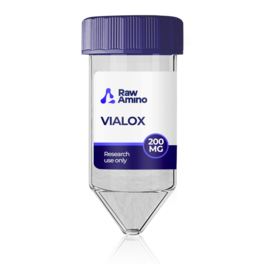
What Is Vialox?
Vialox — also known in research literature as Pentapeptide-3V — is one of the more fascinating compounds currently being explored at the crossroads of neuromuscular science and skin texture peptide research. It is a synthetic peptide derived from snake venom, composed of a five-amino-acid sequence (Gly-Pro-Arg-Pro-Ala, or GPRPA) — a structural origin that immediately sets it apart from many other dermatological research compounds and has made it a subject of growing scientific curiosity.
What makes this Vialox peptide particularly interesting from a research standpoint is its proposed mechanism of action. Rather than working directly on skin structure or collagen production, Vialox appears to interact with the molecular machinery responsible for nerve-to-muscle signal transmission — specifically by acting as a competitive antagonist at nicotinic acetylcholine receptors (AChRs) on the postsynaptic membrane of muscle cells. This proposed mechanism has positioned Vialox as a useful research tool for studying how selective receptor blockade at the neuromuscular junction might influence muscular tissue function and overlying skin texture in laboratory models.
Vialox Peptide and Skin Texture: What the Research Suggests
One of the most actively studied areas of Vialox peptide research involves its potential influence on skin texture and wrinkle formation in laboratory models — driven by its proposed ability to reduce muscular contractions that contribute to dynamic wrinkling in the stratum corneum.
Under normal laboratory conditions, acetylcholine released from nerve endings binds to nicotinic acetylcholine receptors — triggering sodium ion channel opening, membrane depolarization, and subsequent muscle contraction. Vialox, as a proposed non-depolarizing neuromuscular blocker, appears to compete with acetylcholine for binding at these receptor sites in laboratory models. Unlike acetylcholine, however, Vialox does not appear to initiate receptor activity — potentially blocking signal transmission and preventing the muscle contraction that would otherwise contribute to wrinkle formation in the overlying skin tissue.
Experimental data from laboratory studies suggested that Vialox may significantly reduce muscle contractions in research models — with one study reporting a 71% reduction in muscle activity within one minute of exposure, followed by a 58% reduction after two hours. Researchers noted that Vialox exhibits a relatively short half-life in laboratory settings — a characteristic thought to potentially minimize the likelihood of prolonged systemic exposure or unanticipated downstream effects in experimental models.
Longer-term laboratory findings have also been reported. Research suggested that consistent exposure to Vialox over 28 days was associated with an approximately 49% reduction in wrinkle size and a 47% increase in skin consistency in the models studied — findings that researchers have highlighted as preliminary and in need of further investigation to confirm reproducibility across different laboratory conditions. Researchers have described this skin texture peptide’s proposed mode of action as producing muscle-relaxing properties akin to those of tubocurarine — a natural alkaloid — though operating through competitive inhibition rather than permanent structural modification.
Vialox Peptide and Neuromuscular Transmission Research
Beyond its interactions with skin texture in laboratory models, Vialox has also drawn considerable interest as a research tool for studying neuromuscular transmission more broadly — an area that gives this neuromuscular peptide research subject a scientific profile that extends beyond dermatological applications.
Research suggested that Vialox appears to act exclusively on peripheral nicotinic acetylcholine receptors — with minimal impact on central neuronal receptors, as suggested by animal studies. This peripheral selectivity has made it a potentially useful research tool for investigating how targeted acetylcholine receptor blockade at the neuromuscular junction influences downstream signaling — without the confounding effects of central nervous system interactions that complicate the use of less selective research compounds.
The mechanism by which Vialox — also known as Pentapeptide-3V — achieves this selectivity is thought to involve binding to AChR at the post-synaptic membrane, thereby preventing acetylcholine from attaching to these receptors in laboratory models. This blockade is thought to reduce both the frequency and intensity of muscular contractions in laboratory settings — producing a forced relaxation effect that researchers have compared conceptually to compounds such as botulinum toxin, tubocurarine, and curare toxin, while noting that Vialox appears to achieve this through reversible competitive inhibition rather than permanent proteolytic action.
Researchers have also proposed that Vialox may be of interest in neuromuscular peptide research focused on studying certain spastic conditions — including migraines and muscle spasms — in laboratory models. While this remains an early and speculative area of investigation, it has broadened the scientific conversation around Vialox peptide beyond its origins as a skin texture research compound and underscored its value as a multi-application research tool in controlled laboratory environments.
References
- National Center for Biotechnology Information. PubChem Compound Summary for CID 67073230, Vialox. 2024.
- Lupo MP, Cole AL. Cosmeceutical peptides. Dermatol Ther. 2007;20(5):343–349.
- Gorouhi F, Maibach HI. Role of peptides in preventing or treating aged skin. Int J Cosmet Sci. 2009;31(5):327–345.
- Satriyasa BK. Botulinum toxin (Botox) A for reducing the appearance of facial wrinkles: a literature review. Clin Cosmet Investig Dermatol. 2019;12:223–228.
- Lebedev DS, et al. Oligoarginine Peptides, a New Family of Nicotinic Acetylcholine Receptor Inhibitors. Mol Pharmacol. 2019;96(5):664–673.CJC-1295 and GHRP-2 Peptide Blend: Examining the Science Across Growth Hormone, Appetite, and Hormonal Research.
Disclaimer: The information provided is intended solely for educational and scientific discussion. The compounds described are strictly intended for laboratory research and in-vitro studies only. They are not approved for human or animal consumption, medical use, or diagnostic purposes. Handling is prohibited unless performed by licensed researchers and qualified professionals in controlled laboratory environments.