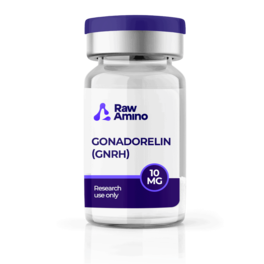

What Is Gonadorelin (GnRH)?
Gonadorelin is a synthetic peptide that researchers believe may closely mirror the body’s naturally occurring gonadotropin-releasing hormone (GnRH) — giving it significant interest as a GnRH peptide in laboratory settings. Also referred to in scientific literature as growth hormone-releasing factor (GHRF), somatocrinin, or somatoliberin, Gonadorelin is composed of 10 amino acids arranged in the following sequence: pyro-Glu-His-Trp-Ser-Tyr-Gly-Leu-Arg-Pro-Gly-NH2 — identical to endogenous GnRH.
In research settings, Gonadorelin is believed to act as a key modulator of two important hormones: follicle-stimulating hormone (FSH) and luteinizing hormone (LH). Scientists have proposed that LH may play a significant role in regulating gonadal functions, potentially including the production of sex steroids such as testosterone, estrogen, and progesterone. FSH, meanwhile, is thought to support the development and maturation of reproductive cells within the gonads.
This gonadotropin-releasing hormone analogue continues to be studied as an investigative tool for understanding hormone regulation, pituitary function, and reproductive processes in mammalian research models.
Gonadorelin and GnRH Receptors
Gonadorelin is hypothesized to interact primarily with GnRH receptors, which belong to a class known as G protein-coupled receptors (GPCRs). Research suggests that when these receptors are activated, they may trigger several intracellular signaling pathways — most notably the cAMP pathway and the phospholipase C (PLC) pathway — both of which are considered important to hormone regulation, particularly the release of LH and FSH from the anterior pituitary gland.
One important consideration in Gonadorelin research is how exposure patterns affect receptor behavior. GnRH receptors appear susceptible to a process called downregulation, where prolonged or continuous activation may reduce receptor sensitivity over time — ultimately diminishing the pituitary’s responsiveness to further GnRH signals. Intermittent exposure, by contrast, may transiently stimulate these receptors and support normal hormone signaling.
Experimental data from Bhasin et al. illustrated this dynamic clearly: continuous GnRH agonist administration was associated with a significant reduction in both the frequency and amplitude of LH pulses by day 28, with levels remaining low thereafter. The study also observed that continuous infusion appeared to produce altered molecular forms of LH with potentially reduced biological activity.
This distinction between continuous and pulsatile exposure patterns is considered a critical variable in Gonadorelin research, and is actively being explored in laboratory models investigating conditions such as anovulation, cryptorchidism, and impaired spermatogenesis.
Gonadorelin and Gonadotropin Hormone Synthesis
When pituitary cells are exposed to Gonadorelin in a pulsatile pattern — mimicking the natural rhythm of endogenous GnRH — research suggests the receptors may recover near-baseline sensitivity within roughly 60 to 90 minutes between pulses. This recovery window appears important for maintaining the characteristic hormonal patterns associated with normal hormone regulation: the spiky LH profile, a more blunted FSH response, and the corresponding fluctuation of testosterone.
Research by Blumenfeld et al. suggests that when experimental pulse sizes mirror the scale of natural hypothalamic bursts, testosterone levels in research models may rise substantially — from approximately 50 ng/dL to above 800 ng/dL over eight weeks. Larger or more frequent boluses, however, may extend the receptor recovery window, potentially blunting subsequent LH and FSH responses and paradoxically dampening testosterone output when pulses are too closely spaced.
These findings highlight the nuanced relationship between exposure protocols and hormonal outcomes — a key consideration in any GnRH peptide research design.
HPG Axis Recovery in Research Models
Experimentation with exogenous androgens in mammalian research models has been shown to suppress the hypothalamic-pituitary-gonadal (HPG) axis through negative feedback, reducing LH and FSH secretion. Research by van Breda et al. explored whether Gonadorelin exposure might support recovery of this axis in such models.
The findings suggested that Gonadorelin may facilitate a relatively rapid reactivation of the HPG axis, with LH rising from below 0.5 IU/L to approximately 7.9 IU/L, and FSH from below 0.5 IU/L to approximately 2.4 IU/L in the research models studied. Testosterone production — previously suppressed to around 4.5 nmol/L — appeared to rise to approximately 13.3 nmol/L following the experimental protocol. Notably, these observed improvements in hormone regulation appeared to persist for more than 12 months in the research models, even without additional Gonadorelin exposure.
Ovulation in Mammalian Research Models
Research by Ferré-Dolcet et al. investigated the potential of a single Gonadorelin exposure to stimulate ovulation in mammalian research models. Acting as a brief but potent GnRH peptide analogue, Gonadorelin appeared to occupy high-affinity GnRH receptors — particularly in models primed by prior estradiol exposure — and provoke a transient but significant release of LH sufficient to push peri-ovulatory follicles past the ovulatory threshold.
This receptor engagement was associated with cumulus expansion, follicular rupture, and the rapid conversion of granulosa cells. Of the research models exposed to Gonadorelin in the study, approximately 84% showed evidence of ovulation, compared to only 37% in the placebo group — a notable difference that continues to make this GnRH peptide an active subject of reproductive research.
Gonadorelin (GnRH) and Cancer Cell Research
Beyond its role in hormone regulation, Gonadorelin has also been explored in a different research context. Maleksabet et al. investigated whether Gonadorelin could be linked to ribonuclease enzymes to create a targeted molecule capable of identifying cancer cells that express the GnRH receptor — such as certain prostate cancer cell lines.
In laboratory experiments, the fusion protein was expressed, refolded, and confirmed to retain RNA-cleaving activity. When applied to receptor-bearing cell lines — including two prostate cancer lines (PC-3 and LNCaP) and a genetically modified kidney line overexpressing the GnRH receptor — growth slowed significantly, and many cells displayed markers of programmed cell death (apoptosis) at concentrations of just a few tenths of a micromole. Receptor-negative cells, by contrast, remained largely unaffected under the same conditions.
The researchers concluded that fusing GnRH to a ribonuclease structure produced an enzyme that may specifically target certain tumor cells in laboratory settings. Further laboratory research is needed to replicate and expand upon these findings.
References
- Zhang L, et al. The Pulsatile Gonadorelin Pump Induces Earlier Spermatogenesis Than Cyclical Gonadotropin Therapy. Am J Men’s Health. 2019;13(1).
- Bhasin S, et al. Hormonal effects of GnRH agonist in men. J Clin Endocrinol Metab. 1987;65(3):568–74.
- Blumenfeld Z, et al. Induction of spermatogenesis and fertility in hypogonadotropic azoospermic men by intravenous pulsatile GnRH. Gynecol Endocrinol. 1988;2(2):151–64.
- van Breda E, et al. Androgenic anabolic steroid use and severe hypothalamic-pituitary dysfunction. Int J Sports Med. 2003;24(3):195–6.
- Ferré-Dolcet L, et al. Disappearance of signs of heat and induction of ovulation in oestrous queens with gonadorelin. J Feline Med Surg. 2021;23(4):344–350.
- Maleksabet A, et al. Specific Targeting of Recombinant Human Pancreatic Ribonuclease 1 using GnRH Targeting Peptide. Iran J Med Sci. 2021;46(4):281–290.
Disclaimer: The information provided is intended solely for educational and scientific discussion. The compounds described are strictly intended for laboratory research and in-vitro studies only. They are not approved for human or animal consumption, medical use, or diagnostic purposes. Handling is prohibited unless performed by licensed researchers and qualified professionals in controlled laboratory environments.