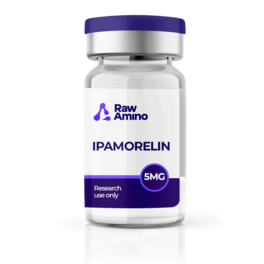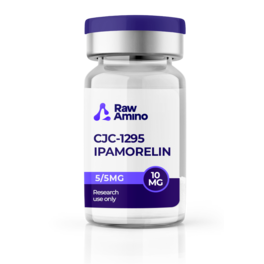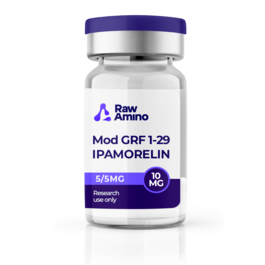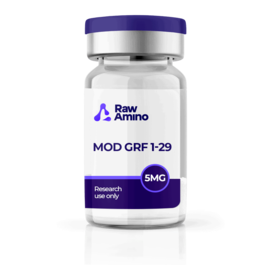

What Is the CJC-1295 and Ipamorelin Blend?
CJC-1295 and Ipamorelin are two synthetic peptides that have attracted considerable scientific interest for their potential to influence growth hormone release mechanisms in pituitary gland cells under laboratory conditions. While each compound is studied individually in research settings, their combination has become a particularly active area of growth hormone peptide blend research — owing to the distinct yet potentially complementary pathways through which each peptide is thought to operate.
CJC-1295 — also referred to in research literature as Mod GRF 1-29 or CJC-1295 without DAC — is a modified analog of growth hormone-releasing hormone (GHRH), the body’s natural regulator of growth hormone synthesis. Research by Jetté et al. identified four specific amino acid substitutions in CJC-1295 — at positions 2, 8, 15, and 27 — each thought to serve a distinct purpose. The substitutions at positions 2 and 15 introduce D-form amino acids less susceptible to enzymatic breakdown, the change at position 27 further limits degradative enzymes, and the substitution at position 8 may strengthen binding to GHRH receptors. Together, these modifications are believed to confer increased stability, receptor interaction efficiency, and an extended period of activity in controlled research settings.
Ipamorelin, meanwhile, is a synthetic peptide studied for its interactions with growth hormone secretagogue receptors (GHS-Rs) — the same receptors targeted by the hunger hormone ghrelin. Research by Raun et al. highlighted that Ipamorelin appears more selective in its receptor activation compared to certain predecessor compounds — potentially influencing growth hormone synthesis without significantly interacting with other pituitary hormones in laboratory models. This selectivity has made it a particularly clean research tool for studying growth hormone secretagogue pathways.
Interactions With Pituitary Cell Receptors
Both CJC-1295 and Ipamorelin appear to interact with receptors on the anterior pituitary gland — specifically on somatotroph cells considered responsible for growth hormone synthesis — though through distinct molecular pathways that have made their combination a subject of particular research interest.
Research by Zhou et al. suggested that CJC-1295 may selectively bind to GHRH receptors on somatotroph cells and potentially induce a conformational change that initiates multiple intracellular signaling events. A key element in this process is thought to involve the activation of G-proteins, which may activate downstream pathways leading to the production of secondary messengers — including cyclic adenosine monophosphate (cAMP) and inositol triphosphate (IP3). Elevated cAMP levels are believed to activate protein kinases that may influence gene expression for increased growth hormone synthesis — potentially promoting the accumulation of growth hormone-containing vesicles within somatotroph cells. IP3, meanwhile, may help liberate calcium ions from internal cellular stores — with rising intracellular calcium levels potentially driving the release of growth hormone into the extracellular environment in laboratory models.
Ipamorelin, by contrast, operates as a GHS-R ligand — binding to ghrelin receptors rather than GHRH receptors. Research by Jiménez-Reina et al. suggested that upon binding, Ipamorelin may activate phospholipase C (PLC) — catalyzing the production of two major second messengers: IP3 and diacylglycerol (DAG). IP3 encourages calcium release from intracellular stores while DAG activates protein kinase C (PKC) — with rising intracellular calcium and PKC activation collectively supporting growth hormone vesicle exocytosis in laboratory models.
The Synergistic Potential of the CJC-1295 and Ipamorelin Blend
The distinct receptor pathways through which CJC-1295 and Ipamorelin appear to operate in laboratory models have led researchers to investigate whether combining them may yield synergistic effects on growth hormone secretion — potentially surpassing what either compound could achieve independently.
Research by Khorram et al. observed that CJC-1295 analogs may promote growth hormone output by approximately 70% to 107% in experimental settings, while research by Gobburu et al. suggested that Ipamorelin may upregulate growth hormone concentrations to around 80 mIU/L — representing roughly a 60-fold increase compared to placebo conditions in laboratory settings.
A literature review by Sinha et al. explored this synergistic hypothesis further — finding preliminary findings from studies examining similar GHRH analogs and GHS-R agonists that support the concept. In certain laboratory investigations, GHRH-like compounds and GHS-R activators were associated with apparent increases in pulsatile growth hormone secretion of 20-fold and 47-fold above baseline respectively — while combining both agents in laboratory settings appeared to produce a 54-fold increase in pulsatile growth hormone output. These findings have positioned the CJC-1295 and Ipamorelin growth hormone peptide blend as one of the more actively investigated combinations in this area of laboratory research.
CJC-1295 and Ipamorelin and Adipose Cell Research
One of the key areas of CJC-1295 and Ipamorelin blend research involves its potential indirect influence on adipose cell biology — primarily through the downstream effects of elevated growth hormone availability in laboratory models.
Growth hormone is widely recognized in research settings for its lipolytic interactions — particularly within visceral fat deposits. Research by Dehkhoda et al. noted that growth hormone may impact adipose tissue in a depot-specific manner, with visceral adipocytes potentially displaying a higher density of growth hormone receptors than subcutaneous adipocytes. Once growth hormone binds to these receptors, it may activate enzymes such as hormone-sensitive lipase (HSL) and adipose triglyceride lipase (ATGL) — facilitating the breakdown of stored triglycerides into free fatty acids and glycerol in laboratory models. By also engaging signaling pathways such as JAK/STAT, growth hormone may drive the transcription of genes involved in lipid mobilization — potentially further promoting lipolysis in visceral fat depots.
By stimulating growth hormone release, both CJC-1295 and Ipamorelin may indirectly support a metabolic shift in laboratory models — with central fat deposits being metabolized and a relative redistribution of adipose tissue from visceral to subcutaneous regions potentially occurring under experimental conditions. Researchers have also noted that Ipamorelin’s interaction with ghrelin receptors in the nervous system may influence hunger hormone signaling in laboratory models — a nuance that adds complexity to the interpretation of adipose-related findings and underscores the importance of carefully controlled experimental design in this area of growth hormone peptide blend research.
Bone Tissue Cell Research
Rounding out this growth hormone peptide blend’s research profile, both CJC-1295 and Ipamorelin have also been studied for their potential interactions with bone tissue cells — an area that has drawn growing interest in laboratory settings.
Research by Svensson et al. observed that Ipamorelin, via its impact on growth hormone levels, may modulate osteoblast function and related progenitor cell activity in laboratory models — potentially leading to better-supported subperiosteal bone formation and an increase in bone dimensions without necessarily altering intrinsic volumetric mineral density. Researchers specifically noted that observed increases in cortical and total bone mineral content appeared to be due to increased bone growth with expanded dimensions — rather than changes in the mineral concentration of the bone matrix itself.
Research by Johansen et al. further suggested that Ipamorelin may influence longitudinal bone growth in laboratory models — apparently by impacting growth plate regions and potentially increasing the linear expansion of bone. Researchers proposed that Ipamorelin’s interactions with bone-associated endocrine loops — involving growth hormone and possibly local IGF-1 — may be central to these observed effects, potentially altering the balance between bone-forming and bone-remodeling processes at the tissue level. While the precise molecular intermediaries remain to be fully clarified, these findings have added a meaningful bone tissue research dimension to the CJC-1295 and Ipamorelin blend’s expanding laboratory research profile.
References
- Jetté L, et al. Human GRF1-29-albumin bioconjugates activate the GRF receptor on the anterior pituitary in rats. Endocrinology. 2005;146(7):3052–8.
- Johansen PB, et al. Ipamorelin, a new growth-hormone-releasing peptide, induces longitudinal bone growth in rats. Growth Horm IGF Res. 1999;9(2):106–13.
- Raun K, et al. Ipamorelin, the first selective growth hormone secretagogue. Eur J Endocrinol. 1998;139(5):552–61.
- Zhou F, et al. Structural basis for activation of the growth hormone-releasing hormone receptor. Nat Commun. 2020;11(1):5205.
- Jiménez-Reina L, et al. Influence of chronic treatment with Ipamorelin in young female rats. Histol Histopathol. 2002;17(3):707–14.
- Khorram O, et al. Endocrine and metabolic effects of long-term GHRH administration. J Clin Endocrinol Metab. 1997;82(5):1472–9.
- Gobburu JV, et al. Pharmacokinetic-pharmacodynamic modeling of ipamorelin. Pharm Res. 1999;16(9):1412–6.
- Sinha DK, et al. Beyond the androgen receptor: the role of growth hormone secretagogues. Transl Androl Urol. 2020;9(S2):S149–S159.
- Dehkhoda F, et al. The Growth Hormone Receptor: Mechanism of Activation and Cell Signaling. Front Endocrinol. 2018;9:35.
- Lall S, et al. GH-independent stimulation of adiposity by GH secretagogues. Biochem Biophys Res Commun. 2001;280(1):132–8.
- Svensson J, et al. The GH secretagogues ipamorelin and GH-releasing peptide-6 increase bone mineral content in adult female rats. J Endocrinol. 2000;165(3):569–77.
- Johansen PB, et al. Ipamorelin, a new growth-hormone-releasing peptide, induces longitudinal bone growth in rats. Growth Horm IGF Res. 1999;9(2):106–13.
Disclaimer: The information provided is intended solely for educational and scientific discussion. The compounds described are strictly intended for laboratory research and in-vitro studies only. They are not approved for human or animal consumption, medical use, or diagnostic purposes. Handling is prohibited unless performed by licensed researchers and qualified professionals in controlled laboratory environments.