

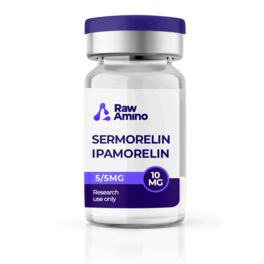
Sermorelin & GHRP-2 – 10MG
$93.00
Discount per Quantity
| Quantity | Discount | Price |
|---|---|---|
| 5 - 8 | 5% | $88.35 |
| 9 + | 10% | $83.70 |
Scientific Overview of Sermorelin & GHRP-2 Blend
The Sermorelin & GHRP-2 blend is a paired peptide research formulation that combines two synthetic compounds commonly studied for their potential actions on growth-related signaling systems. Sermorelin is typically explored as a truncated analog associated with growth hormone–releasing pathways, while GHRP-2 is examined as a separate peptide that may interact with additional upstream regulatory receptors. When studied together, the two appear to form a dual-pathway model for assessing how distinct peptide classes may jointly influence laboratory frameworks involving growth-axis signaling, metabolic processes, and cellular adaptation to stress.
Preclinical investigations suggest that combining these two peptides may amplify certain laboratory endpoints beyond what is observed when either compound is examined independently. This has led researchers to explore whether the pair may produce complementary or synergistic signaling responses in selected in-vitro and in-vivo systems. Their potential interactions with both hypothalamic–pituitary pathways and peripheral metabolic markers continue to be evaluated, although the mechanistic basis of the blend remains an active area of study.
Alternative Names: Sermorelin peptide, GHRP-2 peptide, growth-axis dual peptide blend
Studies and Research Data
Dual-Pathway Signaling Models
Research groups frequently evaluate Sermorelin and GHRP-2 in combination to explore whether dual engagement of separate receptor families may provide heightened or more sustained activation of intracellular processes. Early work proposes that each peptide may initiate signaling through different receptor channels, which could result in amplified downstream responses in controlled research environments. These interactions remain mechanistic hypotheses rather than confirmed pathways.
Growth-Axis Inquiry in Experimental Systems
In laboratory studies, models exposed to Sermorelin have been used to examine hypothalamic and pituitary interactions, while GHRP-2 has been examined for its potential to influence ghrelin-related pathways. When assessed together, some research frameworks report more pronounced shifts in growth-axis biomarkers than when either peptide is isolated. These trends suggest possible complementary actions, although findings vary by model and cannot be generalized.
Metabolic and Energy-Use Exploration
Several studies reviewing GHRP-2 independently have noted possible engagement with metabolic mediators, prompting researchers to investigate whether adding Sermorelin alters these observed trends. In some metabolic models, the blend appears associated with fluctuations in markers related to energy turnover and nutrient partitioning, though such findings are preliminary and remain inconsistent across reports.
Stress-Response and Adaptation Research
Experimental stress-exposure systems—such as oxidative, caloric, or endocrine stressors—have been used to evaluate how peptide combinations may influence cellular resilience. Certain observations indicate that the dual-peptide blend may be linked to more stable experimental readings during stress periods. However, the underlying biochemical patterns remain unclear, and researchers continue to treat these outcomes cautiously.
Synergistic Activity Hypotheses
A recurring theme in these inquiries is the possibility that Sermorelin and GHRP-2 may demonstrate a synergistic pattern rather than simply additive effects. This may be due to their proposed actions on distinct but converging regulatory circuits. How these circuits interact mechanistically has not been resolved, and ongoing studies aim to clarify whether synergy is consistently reproducible or simply model-dependent.
Conclusion
The Sermorelin & GHRP-2 blend is being studied for its potential complementary actions on growth-axis signaling, metabolic pathways, and stress-response frameworks. While laboratory findings occasionally suggest synergistic interactions, the underlying mechanisms remain uncertain and outcomes vary between research models. Current evidence is exploratory, emphasizing the need for further investigation before establishing definitive interpretations.
References
- Smith, Roy G., Sun, Yuxiang, Betancourt, Lorena, and Asnicar, Mark. “Growth hormone secretagogues: prospects and potential pitfalls.” Best Practice & Research – Clinical Endocrinology & Metabolism, vol. 18, no. 3, Sept. 2004, pp. 333-47. doi: 10.1016/j.beem.2004.04.001. PMID: 15261841.
- Muccioli, Giampiero, Baragli, Alessandra, Granata, Riccarda, Papotti, Mauro, and Ghigo, Ezio. “Heterogeneity of ghrelin/growth hormone secretagogue receptors: toward the understanding of the molecular identity of novel ghrelin/GHS receptors.” Neuroendocrinology, vol. 86, no. 3, 2007, pp. 147-64. doi: 10.1159/000105141.
- Kojima, Masayasu, Hosoda, Hiroshi, Date, Yasuhiko, Nakazato, Mitsunobu, Matsuo, Hiroaki, and Kangawa, Ken. “Ghrelin: Structure and Function.” Physiological Reviews, vol. 85, no. 2, Apr. 2005, pp. 495-522. doi: 10.1152/physrev.00012.2004.
- Sigalos, Jason T., et al. “The Safety and Efficacy of Growth Hormone Secretagogues.” International Journal of Clinical Endocrinology & Metabolism, vol. 1, no. 3, 2017, Art. 161085. PMC, PMC5632578.
Disclaimer:
The products mentioned are intended solely for laboratory research and in-vitro experimentation. They are not approved for human or animal use of any kind. All details provided are for educational purposes only. By purchasing from this site, you agree to comply with our Terms and Conditions.
Only logged in customers may leave a review.
Reviews
There are no reviews yet.