
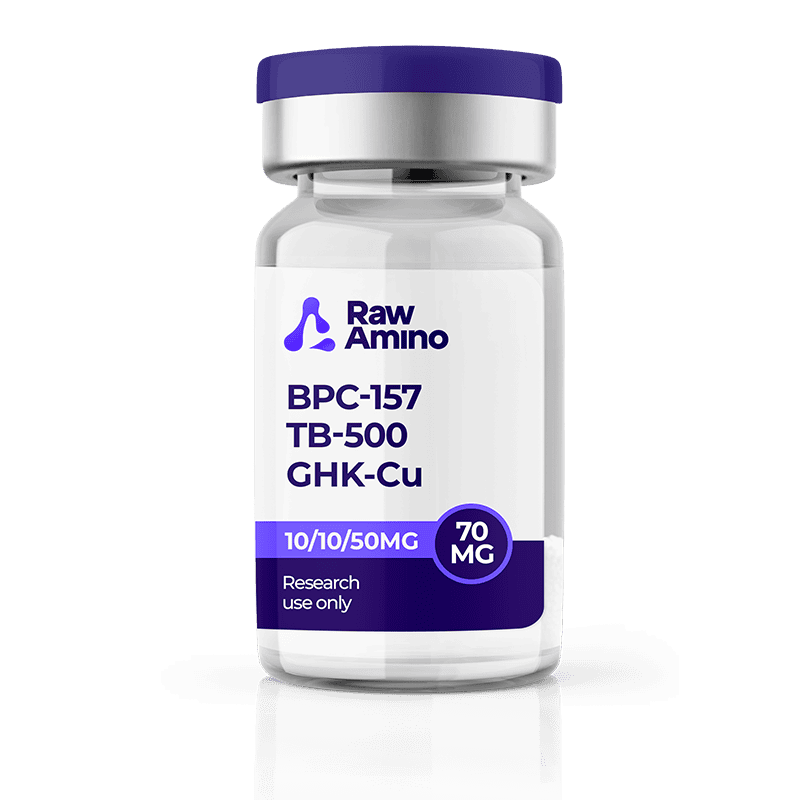
BPC-157 & TB-500 & GHK-Cu – 70MG
$314.00
Discount per Quantity
| Quantity | Discount | Price |
|---|---|---|
| 5 - 8 | 5% | $298.30 |
| 9 + | 10% | $282.60 |
Scientific Overview of BPC-157, TB-500, and GHK-Cu Peptide Blend
The BPC-157, TB-500, and GHK-Cu peptide blend is a multi-component research formulation designed for laboratory investigation of peptide-mediated cellular signaling, extracellular matrix dynamics, and tissue-level regulatory mechanisms. Each peptide in this blend has been independently studied for its potential involvement in cellular repair pathways, cytoskeletal organization, and oxidative balance. When combined, the blend provides a framework for examining overlapping and complementary biological processes within controlled experimental models.
BPC-157 is a synthetic pentadecapeptide derived from a sequence associated with gastric protective proteins and has been explored for its apparent influence on angiogenic signaling, nitric oxide pathways, and cellular migration in vitro. TB-500 is a synthetic fragment of thymosin beta-4, a peptide studied for its role in actin binding and cytoskeletal reorganization. GHK-Cu is a naturally occurring copper-binding tripeptide that has been examined for its potential regulatory role in gene expression, extracellular matrix synthesis, and oxidative stress modulation.
Together, this peptide blend is used in research contexts to explore how multiple peptide inputs may interact across signaling pathways related to cellular structure, matrix remodeling, and stress response regulation. Current literature emphasizes mechanistic exploration rather than definitive biological outcomes.
Alternative Names: BPC-157 (Body Protection Compound-157); TB-500 (Thymosin Beta-4 Fragment); GHK-Cu (Copper Tripeptide-1)
Studies and Research Data
Cellular Migration and Cytoskeletal Dynamics
Experimental studies involving TB-500 have focused on its interaction with actin, a core structural protein responsible for maintaining cellular shape and facilitating intracellular movement. TB-500 appears to sequester G-actin, potentially influencing cytoskeletal reorganization and cellular motility in vitro. BPC-157 has been examined in similar models for its apparent role in modulating cell migration and adhesion, suggesting that combined investigation may provide insight into coordinated cytoskeletal and extracellular interactions.
Extracellular Matrix and Tissue Architecture Models
GHK-Cu has been widely studied in laboratory systems for its potential influence on extracellular matrix components, including collagen, elastin, and glycosaminoglycans. Research indicates that GHK-Cu may affect transcriptional activity associated with matrix synthesis and degradation. When examined alongside BPC-157 and TB-500, researchers may explore how peptide signaling intersects with matrix remodeling, structural protein turnover, and tissue architecture maintenance under experimental conditions.
Angiogenic and Nitric Oxide–Related Pathways
BPC-157 has been investigated for its apparent interaction with nitric oxide signaling and vascular-associated pathways in experimental models. These studies often assess markers related to endothelial activity and angiogenic signaling cascades. TB-500 has also been evaluated in vascular research frameworks due to its association with cell migration and endothelial behavior. The inclusion of GHK-Cu introduces an additional dimension related to oxidative balance and copper-dependent enzymatic systems, allowing for multi-pathway exploration within vascular and connective tissue models.
Oxidative Stress and Gene Expression Regulation
GHK-Cu has been studied for its potential role in modulating oxidative stress through copper-dependent redox mechanisms and gene expression changes. Research suggests that it may influence transcriptional networks involved in cellular defense, repair signaling, and protein synthesis. When combined with BPC-157 and TB-500, the blend enables investigation into how oxidative signaling, cytoskeletal dynamics, and reparative pathways may converge or diverge at the molecular level.
Conclusion
The BPC-157, TB-500, and GHK-Cu peptide blend is utilized in laboratory research to explore peptide-driven signaling across cellular migration, extracellular matrix organization, angiogenic pathways, and oxidative regulation. Current findings are derived from in vitro and preclinical experimental models, with mechanisms remaining under active investigation. Outcomes appear highly context-dependent, reinforcing the need for controlled experimental design and continued mechanistic research.
References
- Sikiric, P., et al. “Stable Gastric Pentadecapeptide BPC-157: Molecular Pathways and Cellular Signaling Implications.” Current Pharmaceutical Design, vol. 17, no. 16, 2011, pp. 1612–1632.
- Goldstein, A. L., and Hannappel, E. “Thymosin Beta-4: Actin-Binding Properties and Cellular Function.” Annals of the New York Academy of Sciences, vol. 1112, 2007, pp. 21–33.
- Pickart, L., et al. “The Copper-Binding Peptide GHK-Cu as a Modulator of Gene Expression and Tissue Remodeling.” International Journal of Molecular Sciences, vol. 19, no. 7, 2018, Article 1987.
- Malinda, K. M., et al. “Thymosin Beta-4 Accelerates Wound Healing by Promoting Angiogenesis and Cell Migration.” Journal of Investigative Dermatology, vol. 113, no. 3, 1999, pp. 364–368.
Disclaimer:
The products mentioned are intended solely for laboratory research and in-vitro experimentation. They are not approved for human or animal use of any kind. All details provided are for educational purposes only. By purchasing from this site, you agree to comply with our Terms and Conditions.
Only logged in customers may leave a review.

Reviews
There are no reviews yet.