
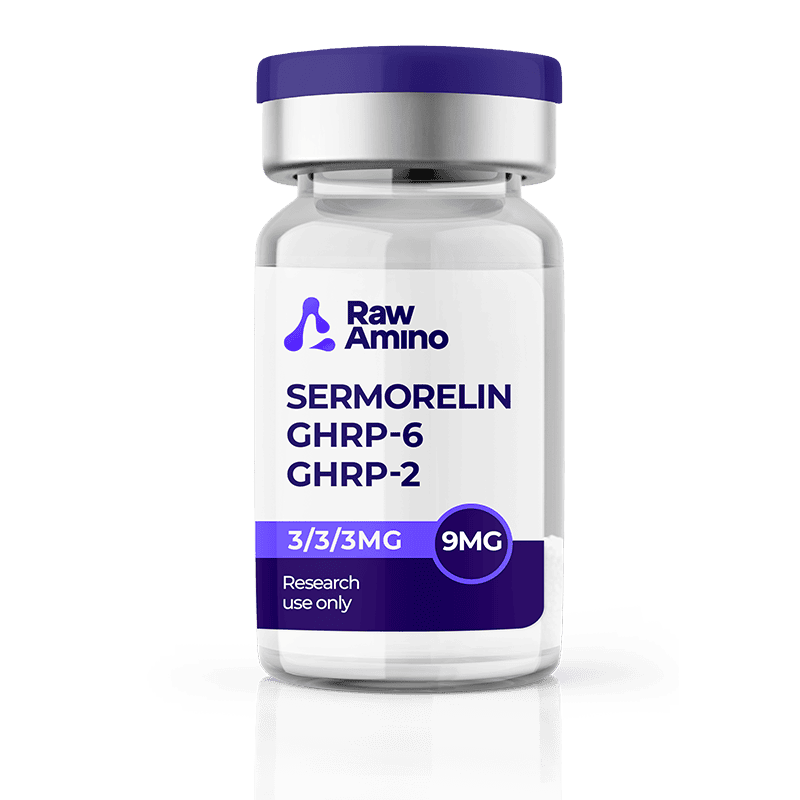
Sermorelin & GHRP-6 & GHRP-2 Blend – 9MG
$91.00
Discount per Quantity
| Quantity | Discount | Price |
|---|---|---|
| 5 - 8 | 5% | $86.45 |
| 9 + | 10% | $81.90 |
Scientific Overview of Sermorelin & GHRP-6 & GHRP-2 Peptide Blend
The Sermorelin & GHRP-6 & GHRP-2 peptide blend is a composite research formulation that brings together three distinct peptides studied for their interactions with growth hormone–related signaling pathways. Each component engages separate but convergent molecular targets involved in hypothalamic and pituitary regulatory systems, making the blend of interest for experimental models examining coordinated endocrine signaling.
Sermorelin is a synthetic analog of endogenous growth hormone–releasing hormone (GHRH) and has been investigated for its capacity to interact with GHRH receptors located on pituitary somatotroph cells. GHRP-2 and GHRP-6 belong to the growth hormone–releasing peptide (GHRP) class and have been studied primarily for their interactions with the growth hormone secretagogue receptor (GHS-R). Research suggests that combining GHRH analogs with GHS-R agonists may result in complementary signaling dynamics in laboratory settings, as the peptides appear to activate distinct intracellular pathways that converge at the level of growth hormone regulation.
Rather than functioning through a single mechanism, this multi-peptide blend has been explored as a tool for investigating how parallel receptor systems may coordinate endocrine signaling, feedback modulation, and pulsatile hormone release in experimental models.
Alternative Names: Sermorelin Acetate; Growth Hormone–Releasing Peptide-2; Growth Hormone–Releasing Peptide-6
Studies and Research Data
Dual-Pathway Pituitary Signaling Models
Research indicates that Sermorelin and GHRPs may activate separate receptor systems within the hypothalamic–pituitary axis. Sermorelin primarily interacts with GHRH receptors, stimulating cyclic AMP–dependent signaling cascades, while GHRP-2 and GHRP-6 engage GHS-R, which is associated with phospholipase C activation and calcium mobilization. Experimental models suggest that simultaneous activation of these pathways may produce additive or synergistic signaling responses compared to single-pathway stimulation alone.
Growth Hormone Secretagogue Receptor Dynamics
GHRP-2 and GHRP-6 have been widely studied as ligands for the growth hormone secretagogue receptor, which is expressed in both central and peripheral tissues. Research suggests that GHS-R activation may influence not only pituitary signaling but also hypothalamic neuropeptide networks involved in appetite regulation and metabolic sensing. Differences between GHRP-2 and GHRP-6 binding characteristics have been explored, with some studies suggesting subtle distinctions in receptor affinity and downstream signaling bias.
Feedback Regulation and Somatostatin Modulation
One area of interest in peptide research involves how GHRPs may interact with inhibitory regulatory mechanisms, particularly somatostatin signaling. Experimental findings suggest that GHRP compounds may partially attenuate somatostatin-mediated inhibition of growth hormone release, thereby altering feedback dynamics within endocrine models. When combined with a GHRH analog such as Sermorelin, this interaction has been examined for its potential to influence signaling amplitude and temporal release patterns.
Neuroendocrine and Metabolic Research Contexts
Beyond pituitary-focused studies, GHRP-2 and GHRP-6 have been investigated for their broader roles in neuroendocrine communication. Experimental models have examined their potential involvement in appetite-related signaling, energy balance pathways, and autonomic nervous system interactions. While these observations remain context-dependent and model-specific, they contribute to ongoing research interest in multi-receptor peptide systems.
Conclusion
The Sermorelin & GHRP-6 & GHRP-2 peptide blend represents a multi-pathway research formulation designed to explore coordinated endocrine signaling. By combining a GHRH analog with two growth hormone secretagogue receptor ligands, the blend has been studied as a tool for examining receptor cross-talk, feedback modulation, and neuroendocrine integration. Current findings are derived from experimental and preclinical research models, and outcomes vary based on study design and biological context. Continued investigation is necessary to further clarify mechanistic interactions and signaling dynamics.
References
- Smith, R. G., et al. “Growth hormone secretagogues: structure, function, and mechanism of action.” Endocrine Reviews.
- Nass, R., et al. “The role of ghrelin in regulating growth hormone secretion and energy metabolism.” Endocrinology.
- Dickson, S. L., et al. “The growth hormone secretagogue receptor: physiology and implications for metabolism.” Physiological Reviews.
- Walker, R. F., et al. “Synergistic interactions between growth hormone–releasing hormone and secretagogues in experimental models.” Journal of Neuroendocrinology.
Disclaimer:
The products mentioned are intended solely for laboratory research and in-vitro experimentation. They are not approved for human or animal use of any kind. All details provided are for educational purposes only. By purchasing from this site, you agree to comply with our Terms and Conditions.
Only logged in customers may leave a review.
Reviews
There are no reviews yet.